

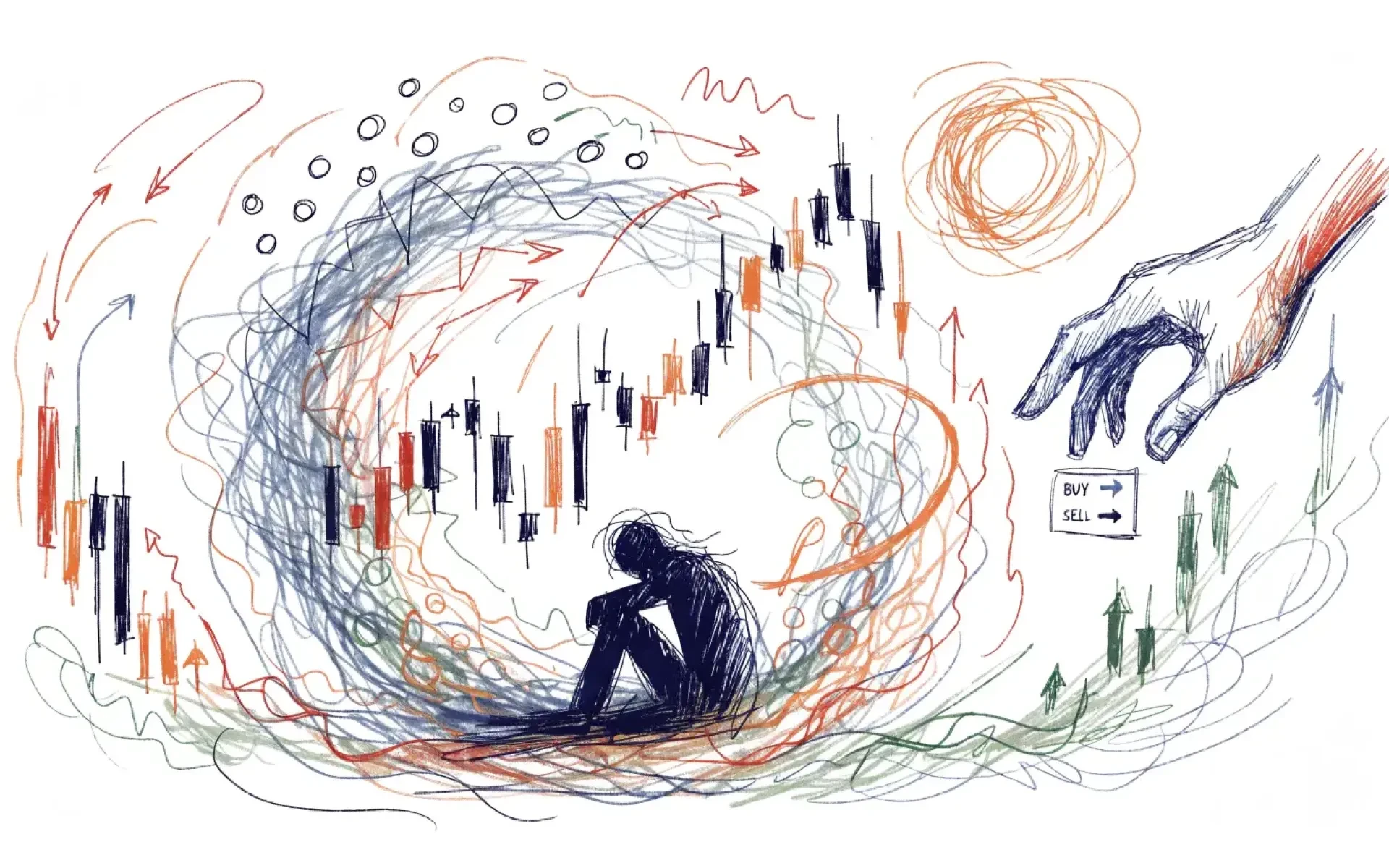
If you have ever sat in front of a screen, your finger hovering over the Buy or Sell button, your heart beating faster than usual just because a candle changed color, you are not alone. Trading is not a game of predicting the future. It is a journey of facing yourself, and fear is often the first companion.
This article does not promise profits, nor does it offer a magic formula. It is distilled from practical experience, trials and errors, and the process of learning to live with the uncertainty of the market. Whether you are just stepping in or have been trading for a while, hopefully, the sharing below will help you see fear more clearly, and more importantly, know how to maintain a steady mindset when the market moves.
Before we begin, I want to clarify: This is a space purely for sharing knowledge. I do not sell anything, have no VIP groups, and do not participate in any fundraising or direct/indirect trading support activities. All content on the website is free. Instead of teaching you how to 'get rich', I hope these articles will be a small shield helping you better defend yourself against the unpredictable fluctuations of the market.
COMMON FEARS AND HOW TO NAME THEM
The market is always fluctuating, but what makes us falter is usually not found on the charts. It lies in how we interpret what is happening. Here are some common fears that many people often mention:
FOMO – Fear Of Missing Out. When prices rise sharply, the mentality of "if I don't enter now, I'll lose the opportunity" often appears. This is not necessarily greed, but the fear of being left behind when seeing others seemingly winning.
Pressure from news. Events like CPI, interest rates, or employment reports often trigger fast and unpredictable volatility. Many worry that a sudden news drop could wipe out profits in just a few minutes.
Chaotic red and green candles, unclear trends. When the market moves sideways or fluctuates without direction, identifying entry points becomes vague. This uncertainty easily leads to hesitation or entering trades based on emotion.
Conflict between indicators. One tool suggests buying, another warns to sell. The H1 timeframe gives a bullish signal, but H4 leans bearish. When signals conflict, the brain often seeks "certainty" – something that inherently does not exist in trading.
Information overload. Too many methods, books, videos, and sharing groups constantly updating. Beginners easily fall into a state of "endless learning but not daring to apply", out of fear of choosing the wrong direction. Read more "Overview of Technical Analysis" at https://vulehuan.com/en/blog/2026/5/overview-of-technical-analysis-aM85zOz0GPC
Fear of cutting losses early only for the price to return, or fear of holding a winning trade too long and watching profits evaporate. These are two sides of the same coin: the fear of making a decision at the wrong time.
Naming the fear doesn't make it disappear, but it helps us stop it from controlling us subconsciously. When you know what you are afraid of, the next step becomes much lighter.
WHY ARE WE AFRAID? THE ROOT LIES IN FINANCIAL PRESSURE
Many people think that weak analytical skills are the main cause of mistakes. However, based on personal observation and community sharing, the root often lies in an underlying factor rarely discussed: is the money being used for trading truly "idle" or not?
When the funds in a trading account affect daily living expenses, bills, or long-term plans, the brain automatically triggers a stress response mechanism. At this point, each trade is no longer a probability test, but becomes a burden of having to "win to protect your livelihood". As a result, we are prone to closing trades early at the slightest shakeout, or holding onto losses because we dare not accept a small defeat.
The market doesn't owe anyone a dime, nor does it care about our personal financial needs. This sounds cold, but understanding it is the key to alleviating invisible pressure.
WHEN SUCCESS ELSEWHERE BECOMES A PSYCHOLOGICAL BARRIER
There is a rather common paradox that many have shared: those who have reaped success in other fields such as business, programming, networking, or personal wealth management sometimes face unexpected challenges when entering trading. This doesn't stem from a lack of capability, but from fundamental differences in how the market operates.
Real-life success is typically built on controlled effort, accumulated skills, and relatively stable predictive abilities. You can optimize processes, manage teams, or forecast revenue based on internal data. But trading is a completely new discipline, where the market does not operate on linear logic or fixed formulas. It is governed by countless variables beyond personal control: institutional cash flows, shifts in monetary policy, geopolitical news, energy prices, inflation, or even sudden natural disasters and crises.
When carrying the mindset of "I did well in this, so trading will be the same", we inadvertently overlook the humility needed to start again from zero. The financial market does not care who you are or what you have achieved outside your trading system. It merely reflects cash flows, probabilities, and collective reactions to new information. Therefore, one of the effective ways to reduce initial mistakes is to accept yourself as a beginner in this field. Discarding overconfidence, learning selectively, and respecting the complexity of the market are the most solid psychological foundations. Success elsewhere is valuable baggage, but in trading, it is humility and the willingness to relearn from scratch that help you stay clear-headed when volatility strikes.
FOUR PRACTICAL STEPS TO REDUCE PSYCHOLOGICAL BURDENS
There is no way to completely eliminate fear, but we can learn to manage it through structured habits.
Step one: Record your emotions. Before and after each trade, take two minutes to write briefly: how did you feel when entering the trade? Were you rushing? Did you follow your plan? A journal is not for self-blame, but for identifying recurring emotional patterns.
Step two: Validate rules before using real money. Backtest on historical data or trade a demo account with a serious mindset. The goal is not to find a "perfect strategy", but to see if your system operates stably under various market conditions.
Step three: Establish hard rules. For example: only trade within the timeframe you understand best, set a fixed risk level per trade, and pre-define conditions that will keep you from entering a trade (such as major news releases, wide spreads, or illiquid markets).
Step four: Controlled practice. Trade according to a checklist rather than intuition. Limit your chart-viewing time each day. Separate your analysis hours from your execution hours. When everything is process-driven, emotions will have less room to creep in.
FOUNDATIONAL PRINCIPLE: IDLE CAPITAL AND SMALL POSITION SIZING
If I had to choose two factors that help many people get through the initial stage more easily, they would be: only use idle capital and enter trades with small position sizes.
Idle capital here isn't just "spare money". It is the amount of money that, even if the market moves against expectations, allows you to continue your normal life without affecting living expenses, resorting to loans, or creating pressure to "recover quickly". When money is detached from everyday financial worries, the brain processes information more clearly. You will find yourself panicking less when the price goes against you, and being less overly euphoric when the price goes your way.
Small position sizing plays a similar role. Many share that when the risk per trade is only between 0.5% and 1% of total capital, or fixed at a small set number, the psychological burden is noticeably lighter. A losing trade then feels like a small tuition fee paid to the market (paying tuition when studying is normal), not enough to derail your finances, but enough for you to draw a lesson. When financial pressure drops, you finally have the space to observe the market objectively, instead of trying to "guess right" to avoid losses.
Remember: the initial goal is not large profits, but building discipline and consistency. Once you can adhere to your plan for many consecutive sessions without being swept away by emotions, adjusting volume will become a natural next step, not a hasty action.
A ROADMAP FOR PSYCHOLOGICAL & DISCIPLINE TRAINING (FLEXIBLE TO YOUR PACE)
Building a sustainable trading mindset does not have fixed milestones. Everyone progresses at different learning speeds, living conditions, and practical experiences. Instead of imposing a specific number, you can refer to the three-step progression below and adapt it flexibly to suit your lifestyle and capabilities.
Initial Phase: Familiarization and Building Basic Habits
During this time, prioritize trading with very small position sizes or on a demo account. The main goal is not to generate profits, but to consistently complete a pre-trade checklist, maintain a trading journal, and learn to accept that losses are a natural part of the trial/learning process. When you are free from the pressure of "having to win", your mind will more easily observe the market objectively, and early mistakes will merely be controlled tuition fees.
Consolidation Phase: Reviewing and Refining Processes
Once accustomed to the market's rhythm, shift the focus from judging the outcome of each trade to conducting periodic reviews (e.g., every weekend). Instead of asking "why did this trade lose", you can ask yourself: "did I strictly follow my established rules?", "which trade was entered out of emotion or haste?", and "are there any signals or market conditions that require additional filters?". This phase helps you gradually transition from the habit of reacting to every single candle towards observing, recording, and calmly adjusting your system on a solid foundation.
Expansion Phase: Controlled Growth and Energy Protection
If you find that you can maintain discipline over many consecutive sessions (for instance, after 3 months) and feel psychologically stable in the face of volatility, you might consider gradually increasing your trading volume. Core principles must still be upheld: do not let losing streaks impact your personal life, and always set an account drawdown threshold you are comfortable with. Upon hitting this threshold, proactively pause, take a complete break from the charts, and only return when your mind is truly clear.
Remember, this is not a race. The market will always be there, and making progress patiently in small steps often brings much greater long-term stability than trying to accelerate in the short term. You can absolutely lengthen or shorten each phase based on your actual feelings, provided discipline and financial safety remain top priorities.
QUESTIONS ABOUT FEAR IN TRADING & COPING PERSPECTIVES
These suggestions are written as reference perspectives, based on basic risk management principles and practical experience, not investment advice. Hopefully, you will find a few touchpoints to adjust your own trading rhythm.
GROUP 1: PRICE & NEWS
- What is FOMO and how to avoid rushing into a trade out of fear of missing out?
FOMO often strikes when the market moves strongly and we feel we are sitting on the sidelines. Instead of trying to chase the price, many people look to revert to their initial checklist: does this trade meet all my entry criteria? If not, waiting is often safer. The market always creates pullbacks, and the next opportunity usually appears when you maintain composure. Using idle capital and small position sizing also helps reduce the pressure of "having to get in at all costs", because you understand that missing a trade does not impact your personal life. - When there is major news like CPI, interest rates, or employment reports, should you close trades, avoid them, or continue trading?
Macroeconomic news often brings fast volatility and abrupt changes in liquidity. There is no single right reaction for everyone, but a common approach is to establish a response plan in advance: reduce volume, avoid opening new positions right near the release time, or pause to observe until the market finds a clear direction. This helps limit emotional decisions when spreads widen or prices gap. Read more "DCA and Hedging: A Lifeline or a Trap for Account Blowouts?" at https://vulehuan.com/en/blog/2026/5/dca-and-hedging-a-lifeline-or-a-trap-for-account-dBBRZyK4W1X - Continuous red and green candles, unclear market trend, should I trade?
When the chart lacks direction, forcing to find a signal sometimes leads to unnecessary entries. Many traders choose to wait until the price breaks out of the accumulation zone or a clearer structure emerges. Not trading during these periods is also a valid decision, especially when you are prioritizing capital preservation and discipline training. - Fear of slippage or fills not going as planned when the market is highly volatile?
Slippage is a factual part of trading, especially during low liquidity hours or unexpected news. Some commonly referenced methods are to limit the use of market orders during sensitive times, prioritize limit orders when appropriate, and accept that a small degree of discrepancy is a natural cost of live markets. - Prolonged sideways markets eroding the account, should I exit or continue to hold?
Sideways is not a negative state, but merely a rhythm of the market. If your strategy is trend-based, identifying the ranging zone early and pausing trading can help preserve resources. If you range trade, clearly define exit points when false breakouts occur. Using small volumes during this phase also helps alleviate stress when the market moves slowly.
GROUP 2: INDICATORS & ANALYSIS
- Indicator A signals buy, indicator B signals sell, which one should I trust?
When signals conflict, it's usually a sign that the market lacks consensus. Instead of searching for the "right indicator", many opt to observe price action, check volume, or switch to a higher timeframe for a broader perspective. Indicators are supporting tools for confirmation, not the ones making decisions for you. - The H1 timeframe shows a buying zone, but H4 leans towards selling, which timeframe should I trade on?
Conflict between timeframes is a common occurrence. A popular approach is to use higher timeframes to determine the primary trend or key support/resistance zones, and then use lower timeframes to refine entry points in that direction. If two timeframes are too divergent, waiting until they realign is usually safer than trying to guess the market's intent. - Too much knowledge and methods, don't know where to start?
Learning is essential, but applying too many things at once easily causes signal noise. Many find it more effective to choose one core method, test it over at least 30-50 trades in live or demo conditions, and only then consider adding new elements. Intentional simplicity often keeps the mind clearer than a complex system. Read more "Investment Analysis Approaches for Beginners" at https://vulehuan.com/en/blog/2026/5/investment-analysis-approaches-for-beginners-eZ6mQlMvK4R - Fear of not catching the exact top or bottom, entering late when the price has already run?
The desire to catch turning points is natural, but the market does not reward guessing exact extremes. Many experienced traders generally focus on participating once the trend has been clearly confirmed. Entering a bit late but within a safe structure typically brings greater long-term stability compared to entering early without a solid basis. - Are lagging indicators like MA, RSI, or MACD still useful in fast-moving markets?
Lagging indicators do not predict the future, but they can aid in confirming trends, measuring momentum, or warning of divergences. When paired with price observation and market context, they remain valuable reference tools. What matters is understanding the limitations of each tool and not expecting a single indicator to replace a risk management process.
GROUP 3: DECISION MAKING & CAPITAL MANAGEMENT
- Fear of cutting losses early only for the price to return to its original intended direction?
This feeling is very real, but a stop loss is not a failure, it's a tool to protect your account. Instead of placing stop losses emotionally, you can refer to the Average True Range (ATR) indicator to measure market volatility and determine a stop loss distance more suited to the actual price rhythm. Of course, there is no way to completely avoid the price sweeping your stop and then turning back, but using ATR helps you place cut losses based on data rather than guesswork. Accepting that a portion of trades will hit their stops is a normal part of trading probabilities, helping you keep your psychology more stable. - Fear of holding a winning trade too long and seeing profits shrink?
Take profit is a skill that needs to be honed alongside stop losses. Some choose to take partial profits when the price hits a short-term target, or trail their stop-loss favorably to protect gains, viewing the exit as an independent trade in the opposite direction: if you meticulously analyze the reasons for entry, the reasons for exiting the market should also be clearly defined in advance. Rather than taking profit based on emotion or subjective expectations, set targets based on price structure, key resistance/support zones, or calculated risk-to-reward ratios. Having transparent take-profit rules from the start will diminish hesitation or regret if the market reverses, while maintaining objectivity throughout the trading session. - Fear of consecutive drawdowns leading to discouragement and quitting trading?
Losing streaks are unavoidable in any system. When the risk per trade is capped at a small level (e.g., 0.5%–1% of total equity), even a string of unfavorable trades will not severely impact the account. Many also institute rules for a temporary break when drawdowns hit a specific threshold, avoiding decision-making while fatigued or unfocused. - Fear of overtrading out of boredom or a desire to recover a losing trade?
Overtrading typically stems from a need to "take action" rather than waiting for a genuine opportunity. A helpful method is to limit the maximum number of trades per day, only trade during fixed timeframes, and record the reasoning for each entry in a journal. When trading volume is kept small, the pressure to "win to recover" significantly decreases, making it easier for you to stick to your plan. - Fear of not sticking to the plan even after writing it out meticulously?
A plan only works when you feel secure executing it. If position sizing is too large compared to your psychological tolerance, the brain often automatically finds ways to break the plan to reduce stress. This is why many emphasize using idle capital and small trade sizes: when risk levels are within your control, following rules becomes lighter and more natural.
GROUP 4: PSYCHOLOGY & HABITS
- Fear of "jumping" to another strategy whenever encountering a losing streak?
- Constantly changing methods often makes it difficult to assess which elements are truly effective. The market is like a seasonal business: selling raincoats in the rainy season, selling umbrellas in the sunny season - each period suits a different approach. Even within a single year, the market has its own "seasons": strong trends, sideways movements, or high volatility driven by news. Thus, no single method guarantees consecutive wins across all conditions.
- A flexible approach involves combining psychology with position sizing (volume) adjustments based on the "favorability" of the signal. For example: when both H1 and H4 timeframes signal a buy, you might set higher expectations (like an H4 resistance zone) and maintain planned volumes. But when H1 signals a buy while H4 leans bearish, this conflict shows the market lacks consensus - at that point, reducing volume or lowering profit expectations is a way to protect your account while still participating and observing. If strategy tweaks are needed, change one small element at a time and record its impact, rather than discarding the entire old process.
- Feeling discouraged when seeing others share profits or achievements on social media?
- Social media often reflects only a very small fraction of the big picture. People typically share only what they want you to see: lose 9 trades, win 1, but post only the winning trade; or they trade two opposing accounts, always having one side to flaunt profits. Furthermore, images and screen-recording videos can be created from fake apps, or come from opaque platforms where numbers can be manipulated. There are cases where cent accounts are displayed as large balances, making viewers think the profit is "1000 USD" when in reality it's just 1000 cents (equivalent to 10 USD).
- A useful question you can ask yourself is: "Why does this person want to share this with me?". The motive could simply be to attract participants through referral links (IB), or more complexly for untransparent purposes. If the content they share stops solely at profit figures without providing learning value, analysis, or useful perspectives for your trading journey, proactively limiting exposure - even hiding or unfollowing - is a reasonable way to protect your psychology and focus. Everyone has different goals, capital pools, and risk appetites; your journey does not need to be compared to anyone else's.
- Does success in business, tech, or other fields make trading easier?
Success in other fields is proof of capability and perseverance, but trading is a discipline with unique characteristics. Financial markets do not operate on linear logic or fixed formulas; they are influenced by institutional cash flow, macroeconomic policy, geopolitical turbulence, commodity prices, inflation, and unexpected events. Bringing confident attitudes from elsewhere into the market without the humility to learn from scratch sometimes becomes an invisible barrier. Accepting yourself as a beginner, respecting the market's complexity, and starting with idle capital and small position sizing is usually a solid foundation for the long run. - How to know when to take a break from trading to regain your psychological balance?
Taking a break is not a sign of failure, but a part of energy management. Some common signs include: feeling irritable when viewing charts, entering trades continuously against the plan, losing sleep over positions, or feeling that financial pressure is overriding your clarity. At such times, a complete timeout away from the screen can help you return with a more balanced perspective. - How to turn fear into a warning tool rather than a barrier?
Fear, in moderation, is the brain's natural defense mechanism. When you trade with idle capital and small position sizes, fear is no longer a panic alarm, but gradually becomes a gentle reminder: "recheck your checklist, confirm the rules, stay calm". Over time, this alertness helps you avoid costly mistakes and builds a habit of intentional decision-making, rather than reacting to fleeting emotions.
CONCLUSION
Technicals help you know when to enter a trade. Capital management and psychological discipline are what keep you around long enough to learn and adapt. Trading is not a sprint, but a journey of patience and self-awareness.
If you are just starting out, allow yourself to make controlled mistakes. If you already have experience, review old habits to see if anything needs tweaking to alleviate unnecessary burdens. The market will always be there. The important thing is whether you can protect your own composure.
This is a space purely for sharing knowledge. I do not sell anything, have no VIP groups, and do not participate in any fundraising or direct/indirect trading support activities. All content on the website is free. Instead of teaching you how to 'get rich', I hope these articles will be a small shield helping you better defend yourself against the unpredictable fluctuations of the market.
⚠️ Disclaimer: This article is for educational purposes and informational reference only, and does not constitute financial investment advice. The cryptocurrency and stock markets involve high risk. Please do your own thorough research (DYOR), comply with local laws, and consult a financial expert before making any investment decisions.