

Hi everyone,
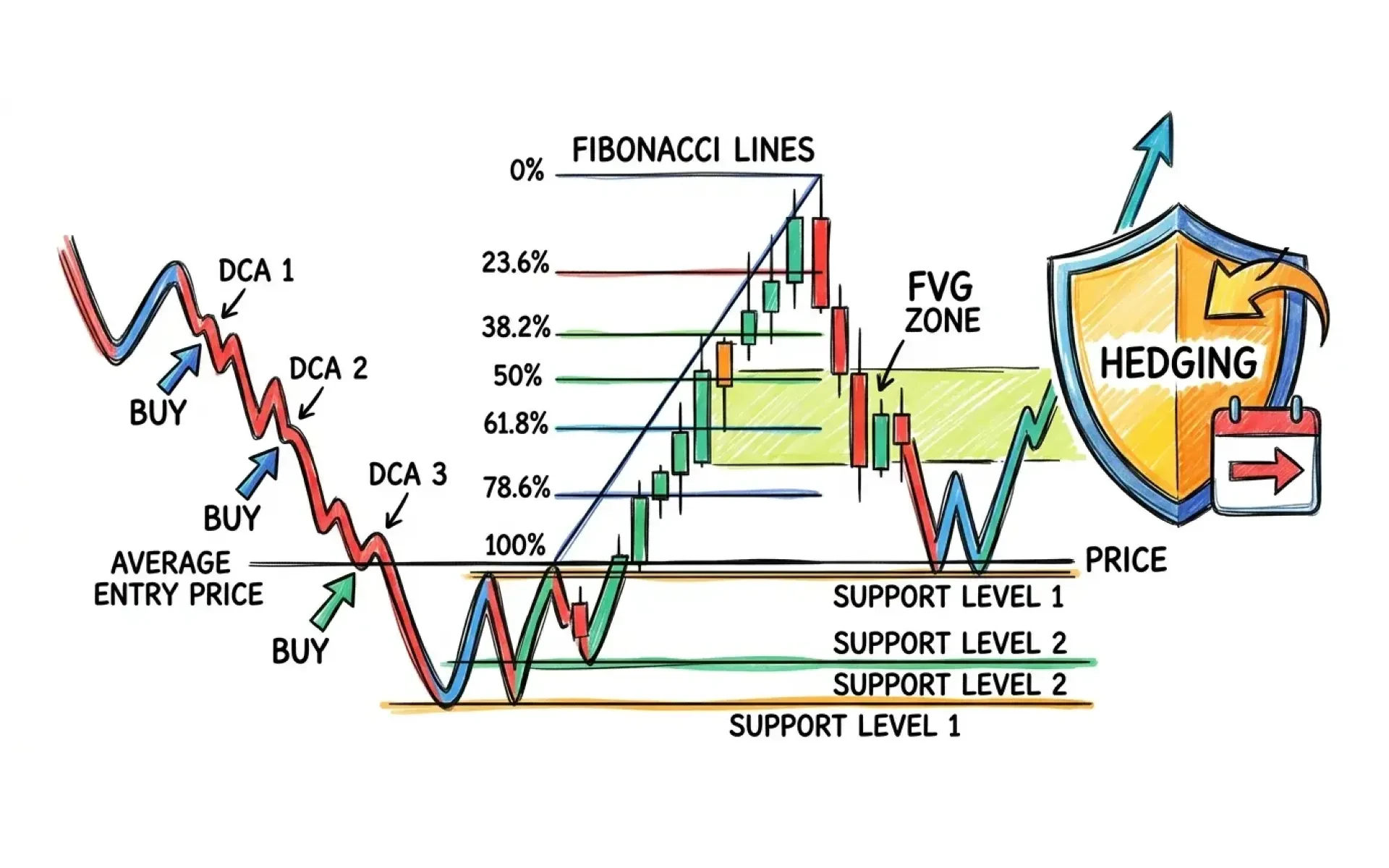
If you've spent time in any trading community, you've likely heard two terms repeated like mantras: DCA (Dollar-Cost Averaging) and Hedging.
Beginners often see them as safety nets: "Price dropping? Just buy more." "Market too volatile? Open an opposite trade to lock the loss." That sounds safe, but it isn't. Both strategies need discipline and clear rules. Used carelessly, they backfire and cause serious damage.
This article covers their strengths and their traps. The goal is simple: help you trade with more clarity and less fear.
Before we begin, I want to be clear: This is a space for pure knowledge sharing. I don't sell anything, I don't have VIP groups, and I don't engage in fund management or direct/indirect trading support. All content on this website is free. Instead of teaching you how to 'get rich,' I hope these articles serve as a small shield to help you better defend yourself against the unpredictable fluctuations of the market.
The DCA Trap: Why "Buying the Dip" Can Blow Your Account
DCA is simple in theory. Instead of buying all at once, you split your capital and buy at different prices to lower your average entry. For long-term investing, it works well. For short-term trading, especially crypto, it can be a double-edged sword.
The Danger of Blind DCA
Imagine buying Bitcoin at $65,000. Price drops to $64,000, so you buy more. It drops to $63,000, and you buy again. Soon your reserve cash is gone, and price is still falling. That is not a strategy. That is hope, and hope is not a trading plan.
Blind DCA means "averaging into a black hole." You run out of capital before the market finds a bottom. When price finally reverses, you have no money left to use the opportunity. Or worse, you stay deep in loss because you bought too early.
The Right Way: DCA at Technical Confluence
Treat every add-on purchase as a separate, calculated trade. Don't buy just because price looks "cheap." Wait for price to reach key technical zones:
- Support and resistance: Is price at a historical floor where buyers stepped in before?
- Fibonacci retracement: Has price pulled back to 0.5, 0.618, or 0.786?
- FVG and imbalance: Is there an unfilled gap below your entry that price may return to fill?
- Confluence: Do several factors align? For example, Fib 0.618 plus old support plus an FVG.
Example: You open a Long ETH position at $3,000 and plan your DCA in advance:
- Level 1: $2,850 (near major support).
- Level 2: $2,750 (Fib 0.618, overlapping an FVG).
- Level 3: $2,600 (strong support, only if needed).
Waiting for clear signals stops you from catching a falling knife. You accumulate at real value zones where the probability of success is higher. Waiting tests your patience, but it protects your capital.
The Hedging Labyrinth: Protection or Paralysis?
Hedging is like temporary insurance for an open position. Instead of closing your original trade, you open an opposite trade to neutralize volatility. For example, if you are Long BTC, you open an equal-size Short. See more in Two-Way Trading: Mastering Buy, Sell, Limit Orders, and How to Make Money Even When Prices Fall.
When Should You Use Hedging?
Hedging is for specific situations, not a daily habit. Three cases:
- Holiday or weekend volatility: Markets may close, but news does not. Gaps can appear when markets reopen.
- Major news events: NFP, Fed rate decisions, or CPI can cause sudden spikes.
- Abnormal volatility: When price is choppy with no clear direction, hedging buys you time to think.
The Hidden Costs of Hedging
- Unwinding: Opening a hedge is easy. Closing it is hard. Close the winning leg too early and you lose protection. Close the losing leg too late and you lock in a large loss.
- Swap fees: Hold a hedge for days or weeks, and fees eat your balance even when price does not move.
- Psychology: Hedging creates a false sense of safety. You now manage two trades instead of one. It does not fix a bad analysis; it only delays the decision.
Example: You are Long SOL at $150. NFP is due in 2 hours. You expect volatility but not direction, so you open an equal-size Short.
- Scenario A: Price spikes to $160. Long gains, Short loses. Total change: about $0, minus fees.
- Scenario B: Price drops to $140. Long loses, Short gains. Total change: about $0, minus fees.
After the news, you close the Short and keep the Long. That is hedging done right: buying time.
Conclusion
For most beginners, the best advice is: master the Stop Loss first. A hard stop is clean. It accepts that you were wrong, protects your capital, and lets you move on. DCA and Hedging are more complex. They require emotional control, technical knowledge, and strict discipline.
If you use them:
- DCA: Only add at major technical confluence zones. Never chase a falling price without a plan.
- Hedging: Use it sparingly, only for major events. Always plan how you will exit the hedge before you open it.
FAQ: DCA and Hedging
Understanding the Basics
- How is DCA different from "holding a loss"? DCA is planned, with defined entries and capital allocation. Holding a loss and buying more is usually an emotional reaction.
- Is Hedging the same as "locking"? Locking is a simple form of hedging. Hedging is broader: you can adjust size or use correlated assets.
- Why are they called double-edged swords? They create a false sense of security. Traders may ignore risk management and open positions that are too large.
- What is the core difference? DCA improves your average entry price. Hedging protects current asset value from short-term volatility.
- Should beginners start with DCA or Hedging? Neither is ideal. If you must choose, structured DCA is safer than Hedging.
DCA Techniques
- Why not DCA on every small drop? Price can fall much further. Without a technical reason, you are guessing the bottom.
- What is FVG? A Fair Value Gap is a 3-candle pattern created by a fast price move. Price often returns to fill the gap.
- How do I use Fibonacci? Draw from the recent swing low to swing high. DCA at 0.5, 0.618, or 0.786, especially when it aligns with support.
- What is imbalance? Strong buying or selling leaves unfilled orders. Price tends to return to rebalance these zones.
- How much capital per DCA? There is no fixed number. Split capital into 10-20 parts and use one part per entry.
Hedging Techniques and Risks
- When hedging instead of a stop loss? When you believe the long-term trend is intact but expect a short-term shock.
- Does hedging protect against bad news? It neutralizes short-term price movement, but swap fees and unwinding still carry risk.
- How do swap fees affect hedging? Long hedges lose money to fees. Use hedging only for short periods.
- Why is unwinding hard? You must time the exit of one leg correctly. A wrong exit can cause a double loss or missed profit.
- Most common mistake? Closing the winning leg too early and losing your protection.
Capital Management and Psychology
- How do I stay calm when deep in the red? Accept that the plan may be wrong. Set a max loss limit before you start. If you hit it, stop and learn.
- Successful DCA example? BTC drops to $60k, aligned with Fib 0.618 and an H4 FVG. You DCA there, and price bounces.
- Failed hedge example? You hedge before news, then the market goes sideways for two weeks. Swap fees take 5% of your account.
- Should I combine DCA and Hedging? Only professional traders should try. It is complex and easy to confuse.
- What tools help? Excel or an online Position Size Calculator. Always calculate the worst case first.
Trading is not about being right all the time. It is about surviving long enough for probability to work in your favor. Respect your capital, and it will reward you.
This is a space for pure knowledge sharing. I don't sell anything, I don't have VIP groups, and I don't engage in fund management or direct/indirect trading support. All content on this website is free. Instead of teaching you how to 'get rich,' I hope these articles serve as a small shield to help you better defend yourself against the unpredictable fluctuations of the market.
Wishing you safe, humble, and continuous learning in your trading journey.
⚠️ Disclaimer: This article is for educational and informational purposes only and is not financial investment advice. Cryptocurrency and stock markets carry high risk. Please Do Your Own Research (DYOR), comply with local laws, and consult a financial expert before making any investment decisions.