

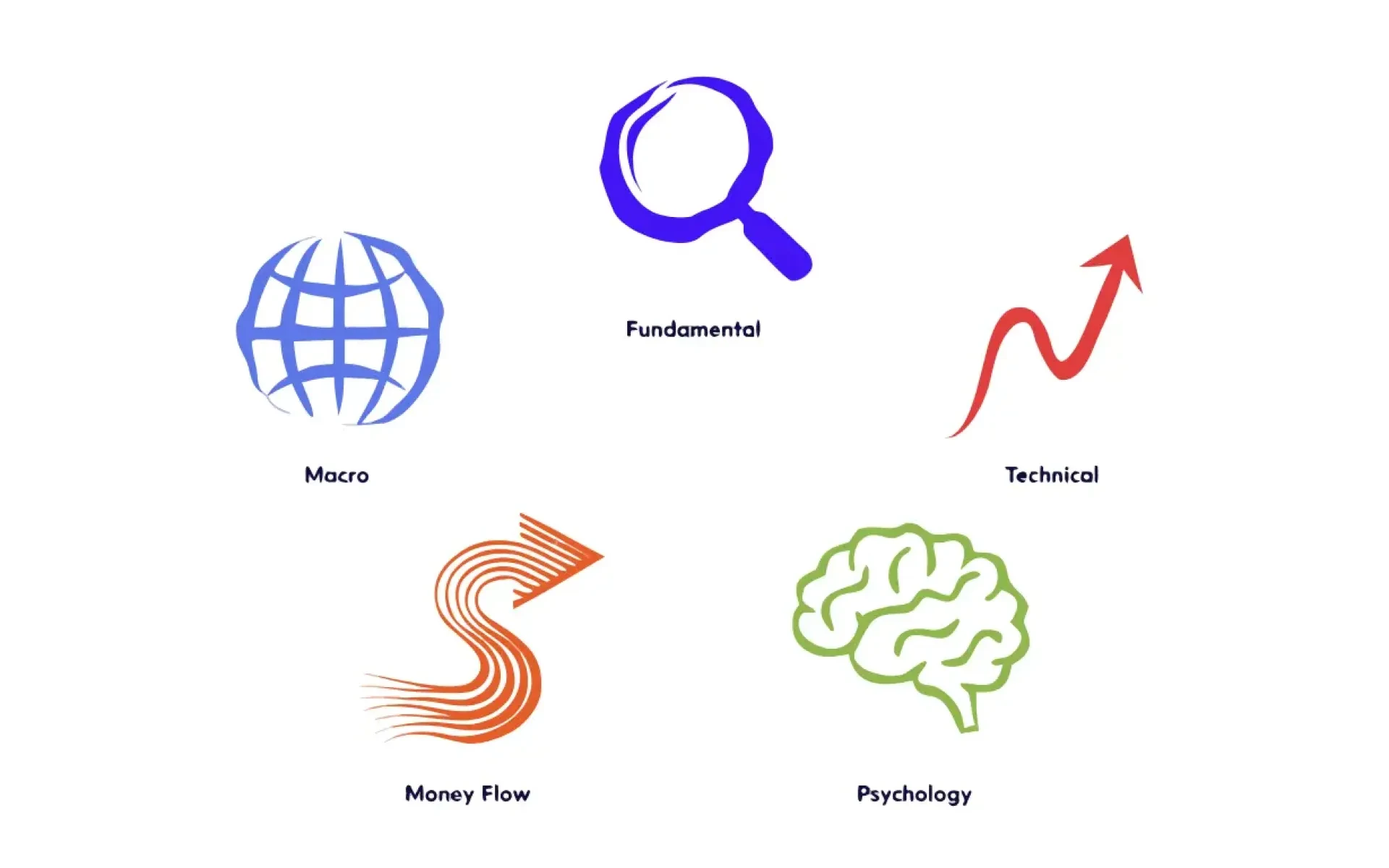
Have you ever felt like you are standing at a crossroads, with a crowd on one side screaming "Buy now!" and cold-headed experts on the other advising "Wait and see"? And you, with your wallet trembling, don't know who to listen to?
Welcome to the world of investing. A place where information is abundant, but clarity is scarce.
The truth is, there is no single "holy grail" in investing. But there are roadmaps. These roadmaps are the analytical approaches. Understanding them won't turn you into a millionaire overnight, but it will help you sleep better at night and make decisions based on data rather than emotions.
Today, we will break down the main analytical approaches in the simplest terms, so you can find the right "weapon" for yourself.
Fundamental Analysis (FA): The Asset's "Health Check"
Imagine you want to buy a house. You wouldn't just look at the color of the paint on the outside. You would check the foundation, the electrical system, the location, and the potential for future price appreciation. That is exactly what Fundamental Analysis is.
What is it?
FA focuses on the intrinsic value of an asset.
- For stocks: You review financial statements, profits, debts, the leadership team, and competitive advantages.
- For Crypto: You evaluate blockchain technology, the development team, the community, tokenomics (the token mechanics), and real-world utility.
Who is it for?
- Long-term investors.
- Patient people who like to "buy low and sell high" based on real value.
- Those who don't have time to watch charts every day.
Pros: Helps you avoid "junk" assets or speculative bubbles.
Cons: Time-consuming to research. The market can remain irrational longer than your liquidity allows.
(The market can remain irrational longer than you can remain solvent - John Maynard Keynes (1883–1946) was a British economist, regarded as one of the fathers of modern macroeconomics).
Technical Analysis (TA): "Reading" the Charts
If FA is looking at a company's health, TA is looking at crowd behavior through price and trading volume.
What is it?
TA is based on the assumptions that: "History repeats itself" and "Price discounts everything". You don't need to know what the company does; you just need to know where the money is flowing through candlestick patterns, trendlines, and indicators (RSI, MACD, Moving Averages, Bollinger Bands, etc.).
Who is it for?
- Short-term and medium-term traders.
- People who like numbers and clear rules (Entry/Exit points).
- Those who want to optimize their buying and selling points.
Pros: Provides more precise market timing. Good risk management thanks to clear stop-loss levels.
Cons: Easily affected by unexpected news. Overusing too many technical indicators at once easily leads to "analysis paralysis", causing you to be confused, hesitant, and miss out on trading opportunities because you cannot make a decisive move.
Sentiment Analysis: Feeling the Crowd's "Temperature"
The market does not run on pure logic. It runs on Fear and Greed.
What is it?
This is the measurement of the general emotions of investors. When everyone is overly euphoric, the market is often at a top. When everyone is panic selling, it is usually a bottom.
- Tools: Fear & Greed Index, Long/Short ratios, Google Trends searches, or discussions on Twitter/Reddit.
Who is it for?
- Everyone. Whether you follow FA or TA, you still need to know the current psychological "weather."
- Contrarian investors.
Pros: Helps you avoid FOMO (Fear Of Missing Out) at the top and panic selling at the bottom.
Cons: Hard to quantify accurately. Emotions can last longer than expected.
Money Flow Analysis: Tracking the "Whales"
In the financial ocean, small fish (retail investors) usually swim in the currents created by whales (institutions, investment funds, high-net-worth individuals).
What is it?
Tracking the movement of large volumes of money.
- For Crypto: Monitoring whale wallets (Whale Alert), and money flowing in and out of exchanges.
- For Stocks: Block trades volume, foreign capital flow.
Who is it for?
- Those who want to ride alongside "Smart Money."
- Investors who want to confirm a trend from TA or FA.
Pros: Money doesn't lie. Prices can be manipulated, but real cash volume is hard to fake.
Cons: Data is sometimes delayed or hard to access with high accuracy for free.
Macro Analysis: Looking at the Big Picture
You cannot row against the tide if a storm is coming. Macro analysis is evaluating global factors that affect your wallet.
What is it?
- Interest rates from the FED/Central Banks.
- Inflation.
- Tax policies and legal regulations.
- Geopolitical tensions.
Who is it for?
- Investors looking to diversify their portfolios.
- Those who want to understand "why" the general market (Bitcoin, Gold, Stocks) is going up or down together.
Pros: Helps you play defense against systemic shocks.
Cons: Highly complex and hard to accurately predict the timing of the impact.
Top 20 Frequently Asked Questions (FAQ) on Analytical Approaches
To save you time, here are quick answers to the most common questions:
Group 1: Concepts & Comparisons
1. How do Fundamental Analysis (FA) and Technical Analysis (TA) differ?
FA answers the question "What to buy?". TA answers the question "When to buy?".
2. I am a beginner, which approach should I learn first?
Start with FA to understand value, then learn basic TA to know how to execute trades. Don't ignore Sentiment to keep a cool head.
3. Is sentiment analysis actually effective?
Yes. Warren Buffett said: "Be fearful when others are greedy, and greedy when others are fearful." That is the direct application of sentiment analysis.
4. What is "Smart Money"?
It is money from large institutions, investment funds, or "whale" individuals. They have better information and resources, so their capital flows often drive the trends.
5. How do macroeconomic factors affect me?
When interest rates rise, money becomes more expensive, and capital usually pulls out of risky assets (Crypto, Growth Stocks) and flows into Bonds or Savings deposits.
Group 2: Choosing Your Style
6. I have limited time, which approach should I follow?
Combine FA + Macro. Choose good assets, buy them at a reasonable valuation, and hold them for the long term.
7. I want to make quick profits (Trading)?
Focus on TA + Money Flow + Sentiment. You need speed and the discipline to cut losses.
8. Can I combine all analytical approaches?
Yes, and that is the best way. It's called Holistic Analysis. Use FA to pick the coin/stock, TA to pick the entry point, Macro to check the broad trend, and Sentiment to manage your emotions.
9. Why is the FA good but the price is still dropping?
Because the market in the short run is a voting machine (driven by emotions/TA), but in the long run, it is a weighing machine (driven by real value/FA).
10. Why is TA sometimes wrong?
Because TA is based on probabilities, not prophecy. Unexpected news (Black Swan events) can break any technical pattern.
Group 3: Tools & Practice
11. What is the most important FA metric for beginners?
For stocks: P/E (Price-to-Earnings), ROE (Return on Equity). For Crypto: Market Cap, Volume, Tokenomics.
12. What is the simplest TA indicator?
Moving Averages (MA) to determine the trend, and RSI to identify overbought/oversold conditions.
13. Where can I measure market sentiment?
The Crypto Fear & Greed Index (for Crypto) or the CNN Fear & Greed Index (for the US stock market).
14. Any free money flow tracking tools?
- Crypto: Etherscan, Whale Alert (Twitter), DefiLlama.
- Stocks: TradingView (Volume profile), foreign trading activity reports.
15. Reliable macro news sources?
Bloomberg, Reuters, CNBC, and the official website of the Central Bank (FED).
Group 4: Mistakes & Psychology
16. What is a fatal mistake when using only TA?
Forgetting the fundamental context. Buying a fundamentally broken coin just because the chart looks nice is the fastest way to lose money.
17. Why do I still lose money despite making a correct analysis?
Because you lack Risk Management. You can be right only 50% of the time, but if you cut your losses quickly and let your profits run, you will still come out ahead.
18. How do I prevent FOMO?
Have a written trading plan. If the price moves past your planned entry point, let it go. There will always be other opportunities.
19. Does FA apply to Bitcoin?
Yes, but differently than stocks. Bitcoin's FA includes: Adoption rate, Hash rate (network security), number of active wallets, and its role as "Digital Gold."
20. How long does it take to master?
You are never completely "done" mastering it. There is no set timeline for everyone. However, with discipline and serious research, many investors can begin to see results after several months to a year of careful real-world practice. Survival is the most important thing, not the speed of getting rich.
Conclusion
Investing is not a race to see who is the smartest, but a race to see who controls their emotions best and has the most solid system.
Don't try to become a master of all schools of thought. Test things out, make mistakes with a small amount of capital, and find the combination that fits your personality. You might be a calm fundamental analyst, or a fast-acting technical trader. Both can be successful.
Wishing you the best in finding your own rhythm in this highly volatile market!
This article is for educational purposes only and is not financial advice. Always do your own research, understand the legal regulations in your country of residence, and consult with a professional before making decisions related to your assets.