

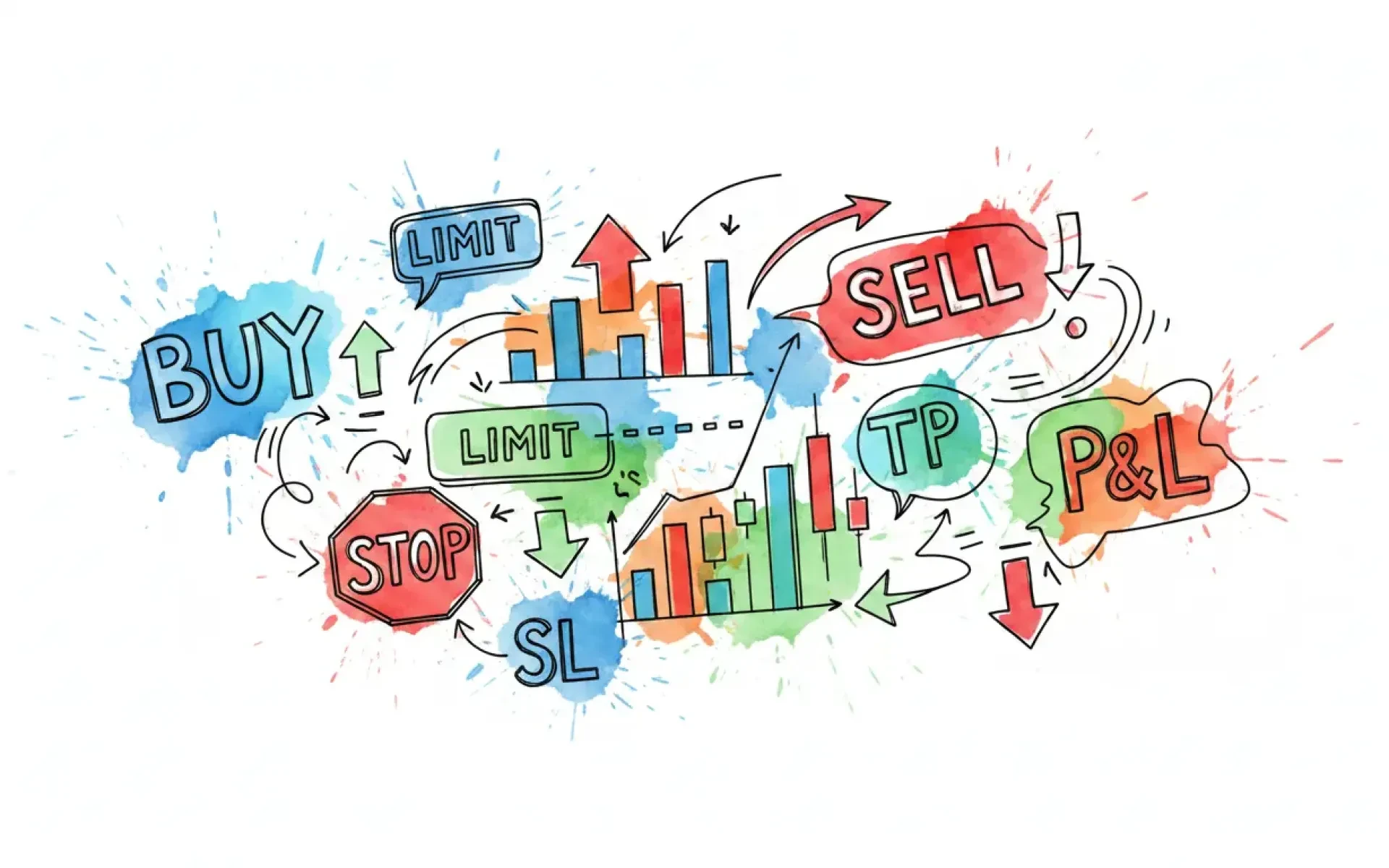
Have you just stepped into the international, derivatives, or crypto markets after a long time of being used to only the Vietnamese underlying stock market?
Welcome to a brand new world. Here, the price board is not just a one-way street of "Buy low – Sell high". You will see terms like Short selling, Buy Limit, Sell Limit, or Take Profit. If you do not understand them clearly, clicking the wrong button and watching your account evaporate is only a matter of time.
Let us break down these concepts together.
The Nature of the Game: Two-Way Money Making (Long vs. Short)
In the traditional market, you can only make money when the market goes up. But in the derivatives or international markets, you can make money regardless of whether the market goes up or down.
The Buy Position (Long) – When you think the price will RISE
- How it works: Exactly the same as buying stocks in Vietnam. You buy at a low price, wait for it to rise, and then sell to take profit.
- Example: You buy 1 Bitcoin at 60,000 USD. Later, the price rises to 65,000 USD, and you sell it. You make a 5,000 USD profit.
The Sell Position (Short / Short Selling) – When you think the price will FALL
- How it works: This is a concept that often confuses many beginners. How can you sell something you do not own? Simply understand that you are borrowing an asset to sell first, and then buying it back to return later.
- Real-world example:
- You borrow 1 tael of gold from a friend when the price is at 80 million VND/tael.
- You take that tael of gold to the shop to sell immediately, walking away with 80 million in cash.
- Exactly as you predicted, the next week the price of gold drops to 75 million VND/tael.
- You use your 80 million to buy back 1 tael of gold at the price of 75 million to return to your friend.
- You still return exactly 1 tael of gold, but you have 5 million VND left in your pocket. That is the profit from short selling!
Entering Immediately vs. Waiting for the Right Time: Market Order vs. Limit Order
Once you have chosen your direction (Buy or Sell), the next question is: Do you want to enter the market right now or wait for a better price?
Market Order – Fills instantly
- Meaning: You want to buy or sell at this exact moment at the best available price in the market.
- When to use: When the market is moving fast and you do not want to miss the opportunity, accepting the current price.
Limit Order – Hunting for a better price
You are in no rush. You want to buy cheaper or sell higher than the current price.
- When you want to BUY (Buy Limit): You place a buy order at a price lower than the current market price.
- Goal: Wait for the price to drop to a cheaper zone before buying in.
- Example: The current price of gold is 80 million. You think it is a bit expensive and only want to buy when it drops to 78 million. You place a Buy Limit at 78 million. When the price hits 78 million, the order automatically fills.
- When you want to SELL (Sell Limit):
- You place a sell order at a price higher than the current market price.
- Goal: Wait for the price to rise to a more favorable zone before short selling it.
- Example: The current price of gold is 80 million. You predict that the price will go up to 83 million before dropping. You place a Sell Limit at 83 million. When the price rises exactly to 83 million, your short selling order will be activated.
Managing the Game: Take Profit, Stop Loss & Closing an Order
Entering the market is only half the battle. Whether you make money or not depends on how you exit the market.
What is Closing an Order (Close Order)?
Closing an order is the action of ending your current trading position to convert your "unrealized profit/loss" into "actual cash."
- If you are holding a Buy position, closing the order means you are Selling it.
- If you are holding a Sell position, closing the order means you are Buying it back to return the asset.
To avoid having to watch the screen 24/7, we use two extremely important automated tools:
- Take Profit (TP): Automatically closes your order when the price reaches your target level to lock in your profit.
- Example when Buying at $60: Set your TP at $65. When the price rises to $65, the order closes on its own, and you pocket a $5 profit.
- Example when Selling at $60: Set your TP at $55. When the price drops to $55, the order closes on its own, and you pocket a $5 profit.
- Stop Loss (SL): Your "safety belt" that automatically closes the order when the price goes against your prediction to limit the maximum loss.
- Example when Buying at $60: Set your SL at $58. If the price drops to $58, the order automatically closes, and you only lose $2 instead of losing more.
- Example when Selling at $60: Set your SL at $62. If the price rises to $62, the order automatically closes, and you only lose $2 while protecting your account.
The Simplest Way to Calculate Profit/Loss (PnL)
When closing an order, how do you know how much you gained or lost? Remember the following formulas:
For a Buy order:
- Profit/Loss = (Close Price - Open Price) x Volume
- Meaning: Close price higher than open price = You make a Profit. Otherwise = You suffer a Loss.
For a Sell order (Short selling):
- Profit/Loss = (Open Price - Close Price) x Volume
- Meaning: Close price lower than open price = You make a Profit. Otherwise = You suffer a Loss.
TOP 20 FREQUENTLY ASKED QUESTIONS FOR BEGINNERS
To make sure you are fully confident before pressing that first trade button, here are the answers to the 20 most common questions.
Category 1: The Nature of Buy/Sell and Short Selling
1. Why can I still press the Sell button when I don't own the asset?
Because the derivatives market allows you to borrow the asset from the broker to sell it first. When you close the order (Close), the system automatically uses your funds to buy that asset back on the market to return it to the broker.
2. How is short selling (Sell) different from selling the stocks I already own in Vietnam?
In Vietnam, you can only sell after you have bought the asset. In short selling, you sell before you buy. You profit when the price goes down, whereas in the Vietnamese market, when the price goes down, you can only sit on the sidelines or take the loss.
3. When I click Buy, who is selling to me? And vice versa when I Sell?
The person matching your order could be another trader who has the opposite prediction, or it could be the broker (market maker) acting as the counterparty to ensure your order is filled instantly.
4. How long can I hold a Buy or Sell position?
It depends on the type of product. With CFDs, Forex, or Crypto, you can hold the position indefinitely as long as your account has enough margin to maintain it (and avoid liquidation). However, you might have to pay a small fee called the overnight fee (Swap).
5. Will a Buy or Sell order be profitable when the market is moving sideways?
When the market moves sideways, neither Buy nor Sell orders yield significant profits. In this context, traders often use Limit orders to buy at the bottom of the range and sell at the top of the range.
Category 2: Limit Orders and Market Orders
6. When should I use a Market order instead of a Limit order?
Use a Market order when highly important news has just broken and the price starts moving aggressively. At that point, you need to get in immediately and do not mind if the price shifts by a few ticks.
7. Why didn't my Buy Limit order fill even though the price touched it?
There are two reasons:
- Due to the Spread (the difference between the buy and sell prices). The price you see on the chart might be the Sell price, while your Buy Limit order only fills when the Buy price touches it.
- Due to the high volume of orders at that price level; your order is queued behind others, and before it was your turn, the price bounced back up.
8. What is the biggest difference between a Buy Limit and a Buy Stop?
Both are pending buy orders, but:
- Buy Limit: Waiting to buy at a price lower than the current price (expecting the price to fall and then bounce up).
- Buy Stop: Waiting to buy at a price higher than the current price (expecting the price to break above a resistance level to continue rising).
9. Can I cancel a Limit order before it fills? Is there a fee?
Absolutely yes, and there is no fee. As long as the order has not been filled, it is just a "promise" on the system. You can cancel or modify it at any time.
10. Does a Limit order expire at the end of the day?
This depends on your settings. Usually, the order stays valid until you actively cancel it (GTC - Good 'Til Cancelled). However, some brokers allow you to set orders that are only valid for the day (Day Order).
Category 3: Take Profit (TP), Stop Loss (SL), and Closing Orders
11. How is closing an order (Close) different from placing a Sell order while holding a Buy position?
Many beginners confuse this.
- Closing an order (Close): Ends the existing position.
- Placing a Sell order while holding a Buy position: On some platforms, this will open an additional, separate Sell position (called Hedging). You will end up holding both a Buy and a Sell position at the same time instead of canceling out the old one. Always use the Close button to exit a position.
12. Why is Stop Loss (SL) the most important order for beginners?
Because markets move very fast. Trading without a Stop Loss is like driving a car without a seatbelt and without brakes. A piece of bad news can completely wipe out your account in just a few minutes.
13. Can I adjust my TP/SL after the order has been filled?
Yes. You can move your TP and SL levels at any time depending on new market developments to maximize profits or minimize risks.
14. What happens if I turn off my computer/phone after setting up my TP/SL?
Your TP/SL orders are already stored on the broker's server. Therefore, even if you turn off your device, lose your internet connection, or go to sleep, the order will still automatically execute exactly when the price reaches those levels.
15. Why was my Stop Loss triggered even though the price on the chart did not touch it?
This is caused by **Spread widening**. When the market is highly volatile (such as during major news releases), the gap between the Buy and Sell prices widens. Even though the chart price has not reached your SL level, the actual counterparty price has touched it and triggered your stop loss.
Category 4: Calculating Profit/Loss and Real-World Trading
16. How do I know whether I am in a profit or loss while my order is still open?
The platform will continuously update this figure in the Positions/Trade section. It is called Unrealized PnL (Unrealized Profit/Loss). This number will constantly fluctuate according to market prices until you click Close Order.
17. When I Sell and the price goes up, I lose money, right? How is it calculated?
Correct. Because you sold first at a lower price and now you must buy back the asset to return it at a higher price.
- Example: You Sell 100 shares of a stock at $50 (taking in $5,000). The price goes up to $60, and you must spend $6,000 to buy them back to return them. Your loss: $5,000 - $6,000 = -$1,000.
18. What is "account liquidation"?
"Account liquidation" (Margin Call/Liquidation) happens when the losses from your open positions exceed the total amount of money you have in your account. The broker will automatically close all your positions to prevent you from going into debt with them. The only way to avoid this is to always set a Stop Loss.
19. What position size should beginners start with to stay safe?
Start with the smallest possible size (for example, 0.01 lot in Forex or a very small amount in Crypto). The initial goal is to get your hands used to the different types of orders, not to make money or get rich right away.
20. Can I both Buy and Sell the same product at the exact same time?
Yes. This action is called Hedging. It is often used by professional traders to lock in a profit or loss when the market is highly unpredictable but they do not want to close out the position entirely.
CONCLUSION & IMPORTANT RISK WARNING
Understanding the different types of orders and how the two-way market operates is a mandatory first step before you start trading. However, theoretical knowledge is only half the battle. To truly master your psychology and execution, you should begin by opening a practice account (Demo) with virtual capital. Practice placing Buy and Sell orders, and setting Take Profit (TP) and Stop Loss (SL) under different market scenarios until all the actions become second nature.
You must take special note that financial trading—especially derivatives, leverage, or short selling—always carries a very high level of risk. The market can fluctuate wildly in just a few seconds due to economic or political news, or changes in liquidity. Without proper risk management knowledge and the disciplined use of Stop Loss orders, experiencing heavy losses or even losing all the money in your account is entirely possible. Never invest money you cannot afford to lose.
Be patient and test your capital management strategies on a Demo account first. Once your "brakes" and "steering wheel" are working smoothly and you have built an ironclad trading discipline, that is when you are ready to enter the market seriously. We wish you safe and successful trading!
Disclaimer: This article is entirely for educational purposes and provides general information only; it is not investment or financial advice in any form. Financial trading always carries the risk of losing capital. You should always do your own research (DYOR), thoroughly understand the current laws in the country you reside in, and consult licensed financial professionals before making any decisions related to your money and assets.