

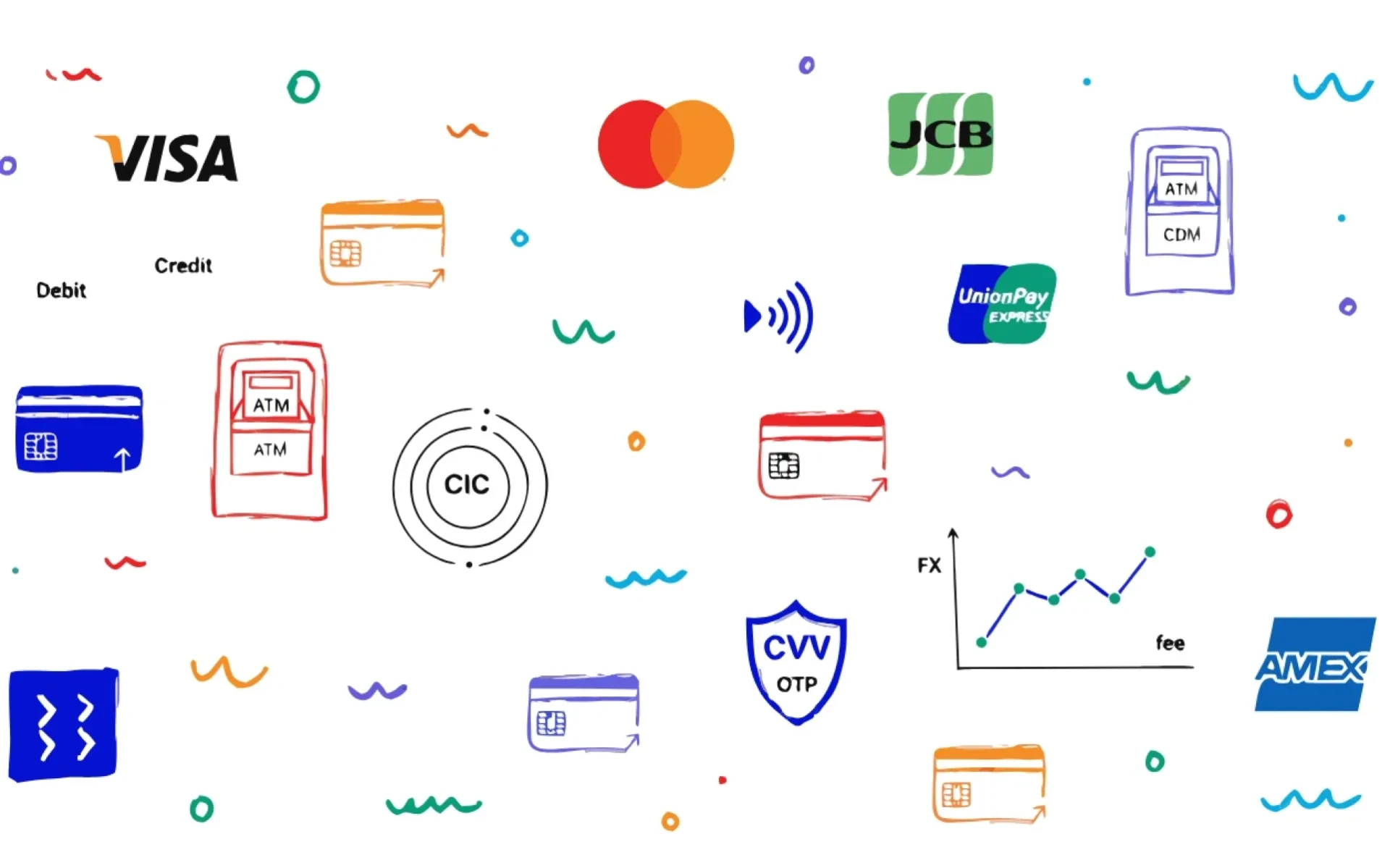
Welcome to the world of banking – where terms might sound complicated, but are actually quite simple if we peel back the layers one by one.
Whether you are a student opening your first account or a professional looking to optimize your wallet, understanding the 'tools' in your hand is the first step toward mastering personal finance. Today, we will "dissect" everything about bank cards, from familiar international brands to concepts like CIC or Hybrid cards that you might not fully know yet.
Grab a cup of coffee, and let's get started!
Who Is The "Boss"? Distinguishing Card Schemes And Banks
The first thing to remember: Banks (such as Vietcombank, Techcombank, VPBank...) and International Card Schemes (Visa, Mastercard...) are two different entities.
- Banks: The place that keeps your money, issues the card, and manages your account.
- Card Schemes: The payment "bridge." They don't hold your money; they provide the infrastructure so your card can be accepted at millions of locations worldwide.
The "Giants" In The International Card World
Instead of looking at a dry comparison table, imagine the characteristics of each type as follows:
- Visa: This is the most popular brand globally. You can use Visa almost anywhere from the US and Europe to Asia. If you are a versatile user who travels to many countries and wants absolute peace of mind regarding acceptance, Visa is the default choice.
- Mastercard: The direct rival to Visa. Mastercard often has excellent promotion programs in Europe and some major global retail chains. Basically, the user experience is similar to Visa, but sometimes you will find more attractive cashback packages depending on the issuing bank.
- JCB: Originating from Japan, JCB is extremely strong in Asia. If you are a foodie, a shopping enthusiast, or frequently travel to Japan, South Korea, or Thailand, JCB cards often offer "huge" deals that other cards don't have.
- UnionPay: The giant from China. UnionPay is growing in Vietnam. This is a suitable choice if you frequently transact with China or want to experience a fresh payment network with many grand opening promotions.
- American Express (Amex): Mentioning Amex is mentioning luxury and high-end service. Amex annual fees are usually higher, but in return, you receive premium perks. This card is suitable for high-income individuals who prioritize airport lounge experiences, travel insurance, and 24/7 customer support.
Quick note: Amex, Visa, and Mastercard are all international organizations; they only differ in their strong markets and partner issuing banks.
NAPAS & VietQR: The “Heart” Of Domestic Payments In Vietnam
NAPAS: Vietnam National Payment Network
- What is NAPAS? National Payment Corporation of Vietnam. This is the unit operating the financial switching system that connects all banks in Vietnam.
- Role: When you withdraw money at Bank A's ATM using Bank B's card, or make an interbank transfer, NAPAS is the “middleman” processing that transaction.
- Why do you need to know? Most domestic ATM cards in Vietnam have the NAPAS logo. It helps you transact conveniently between banks without needing to be in the same system.
VietQR: National Standard Payment QR Code
- What is VietQR? A common QR code standard developed by NAPAS in coordination with the State Bank. Instead of each bank having its own QR code, VietQR creates a single standard.
- Practical benefits:
- You only need to scan a single QR code (with the VietQR logo) using any bank's app to make a payment.
- Supports both merchant payments and fast personal transfers.
- Free or very low fees compared to traditional card swiping.
You can Create a Transfer QR Code at https://vulehuan.com/en/tools/payment-qr-code-generator
The Heart Of The Card: Debit, Credit, Or "2-In-1"?
This is the most important part. Choosing the wrong card type could lead to interest rate troubles or missing out on valuable perks.
Debit Card: "Spend What You Have"
- Mechanism: Money is deducted directly from your payment account as soon as the transaction is successful.
- Advantages: Absolutely safe because you never fall into debt. The card opening procedure is extremely simple, requiring only an ID card. It helps you control spending well because you cannot spend more than your balance.
- Disadvantages: You cannot spend more than your current balance. Cashback programs are usually fewer than those for Credit cards.
- Advice: Start with a Debit card linked to Visa/Mastercard to get used to international payments safely.
Credit Card: "Spend Now, Pay Later"
- Mechanism: The bank advances money for you to spend. At the end of the billing cycle, you must pay back the amount used.
- Advantages: You get interest-free periods for up to 45-55 days. Points accumulation, cashback, and air miles are very attractive. In particular, Credit cards support 0% interest installments for many items.
- Disadvantages: Very high interest rates if you pay late or underpay. Easy to get "caught up" in spending habits beyond your means if you lack discipline.
- Advice: Only use a Credit card if you have good financial discipline and always pay the full balance before the due date.
Hybrid Card: "Double Convenience, Full Of Perks"
Too lazy to carry two cards? The Hybrid card is the solution.
- Mechanism: A single physical card linked to both a Debit account and a Credit limit. When swiped, the system will prioritize deducting money from the Debit account first. If the balance runs out, it automatically switches to using the credit limit.
- Why use it? Convenient because you don't need to carry two bulky cards. Optimized because it still utilizes available funds to avoid unnecessary credit interest.
- Note: Not all banks support this type of card. You need to ask bank staff carefully when opening one.
Installments: A Double-Edged Sword
Credit card installments are an extremely popular feature in Vietnam, especially when shopping for electronics, traveling, or paying tuition fees.
- 0% Interest Installment: Sounds free, but be careful! Usually, you still have to bear a conversion fee or processing fee (about 0.5% - 2%/month).
- Smart calculation: Always ask for the final total amount to be paid. Sometimes, paying upfront with a Debit card and enjoying a cash discount is cheaper than 0% installments with hidden fees.
- Tip: Only use installments for large, necessary expenses and ensure your monthly cash flow is stable.
ATM, CDM, CRM: Don't Confuse Withdrawal And Deposit Points
Standing in front of a bank machine, are you confused about which one does what? Here is a quick guide so you won't be mistaken anymore:
- ATM (Automated Teller Machine): Traditional automated transaction machine. The main function is withdrawing money, transferring funds, and checking balances. This is the most common type, found everywhere.
- CDM (Cash Deposit Machine): A machine specialized for depositing cash into accounts 24/7. Although the name emphasizes depositing, in reality in Vietnam, most modern CDM machines are multi-functional, allowing you to both deposit and withdraw money and transfer funds as conveniently as a regular ATM.
- CRM (Cash Recycling Machine): A multi-functional cash recycling machine. This is an "all-in-one" version that deposits, withdraws, and transfers on the same input/output slot system. This is a new trend that helps minimize maintenance and cash transportation.
Small tip: Look at the symbols or the instruction screen on the machine. If you see a banknote icon going into a slot, it's a CDM/CRM. If you only see a cash dispensing slot, it's a traditional ATM.
CIC: Your Invisible "Credit Profile"
Many people think CIC is something distant, but it actually directly affects your financial life.
- What is CIC? Credit Information Center of Vietnam. It stores your loan and repayment history across the entire banking system.
- Why is CIC important?
- Good CIC: You can easily borrow to buy a house or a car with preferential interest rates, or be granted a high-limit credit card.
- Bad CIC (Debt group): You will be rejected for most new loans and may even find it difficult to open a credit card.
- How to keep CIC clean?
- Pay debts on time, even the smallest late fee or the minimum payment amount.
- Do not open too many accounts/cards at once if not truly necessary.
- Check your CIC periodically via the CIC app or at a bank counter.
Other "Small But Mighty" Concepts
To become a savvy user, you need to understand these 3 additional factors:
Foreign Exchange Fee (FX Fee)
When you swipe a Visa/Mastercard abroad or buy goods online in USD, the bank will charge a fee to convert from foreign currency to VND.
- Fee level: Usually from 2% - 4%.
- Tip: If you travel abroad often, look for cards with low FX fees (under 2%) or those that are completely free.
Contactless Payment
The horizontal wifi-like waves symbol on your card.
- How to use: Just hold the card near the POS machine for 2-3 seconds. No need to insert the card, no need to enter a PIN.
- Benefits: Just 'tap' and you're done – fast, convenient, reduces surface contact, very hygienic, and keeps up with the digital lifestyle.
NFC: The Invisible "Bridge" For Fast Payments
Have you ever wondered: "Why does money automatically get deducted just by holding the card near the machine, without swiping or entering a PIN?" The answer lies in NFC.
- What is NFC? Simply put, NFC is technology that helps two devices (your card and the payment machine) "talk" to each other when they are extremely close. It’s like an invisible, high-speed bridge.
- Practical applications:
- On bank cards: If you see the horizontal wave symbol on the card, it means the card has an NFC chip. You just need to tap the card on the wave logo on the POS machine to pay.
- On phones: NFC also helps you turn your phone into a wallet. Once you've linked your card to Apple Pay, Samsung Pay, or Google Pay, you just need to tap the back of your phone against the payment machine instead of taking out your card.
- Benefits for beginners: No need to remember to bring multiple physical cards, no worries about losing cards, and transactions happen in an instant.
If your phone has NFC, try activating the e-wallet feature (like Apple Pay/Samsung Pay). This is a great first step to experiencing a modern cashless lifestyle.
Although NFC only works at a very close range (less than 4cm), in crowded places like subways or festivals, there is still a risk of being skimmed if someone brings a reader close to your wallet. For absolute peace of mind, turn off the NFC feature on your phone when not in use, or use a wallet with an RFID blocking layer if you frequently move through crowds.
Security: CVV/CVC Code & OTP
- CVV/CVC: The 3 italicized numbers on the back of the card. This is the "key" for online payments. Never take a photo and send it to anyone, including bank staff.
- OTP: An authentication code sent to your phone. The final layer of protection. If anyone asks you for an OTP, it is 99.9% a scam.
Top Frequently Asked Questions About Bank Cards
To save you time, I have summarized the most common questions:
About Card Brands
- What is the difference between Visa and Mastercard? -> Basically equivalent. Choose based on the offers from the issuing bank.
- Can a JCB card be used in the US? -> Yes, but fewer places accept it compared to Visa/Mastercard. It’s best to have a backup Visa/Mastercard.
- Is UnionPay safe? -> Yes, UnionPay is completely safe and is one of the largest card organizations in the world. According to annual reports from The Nilson Report (a reputable organization tracking the global payment industry), UnionPay has led in the number of cards issued for many years (surpassing both Visa and Mastercard), thanks to the massive market in China and strong international expansion. UnionPay's security system complies with strict international standards similar to Visa or Mastercard.
- Is Amex popular in Vietnam? -> Increasingly popular, especially at high-end hotels, restaurants, and airports.
About Card Types
- Debit or Credit, which is better? -> Neither is better, only which is more suitable. Debit for safety, Credit for optimizing benefits.
- Are 2-in-1 cards double-charged? -> No, you only pay the annual fee for one physical card.
- Can students open a Credit card? -> Yes, if they have a guarantor or can prove income from part-time jobs.
- Who decides the credit limit? -> The bank, based on your income and CIC history.
About Installments & Fees
- Is 0% installment truly free? -> Usually, there is a conversion fee. Read the terms carefully.
- How much is the foreign currency conversion fee? -> Average 2-4%, depending on the bank.
- Can the Credit card annual fee be waived? -> Yes, absolutely. There are 3 common ways:
- First-year offer: Some banks in Vietnam waive the annual fee for the first year when opening a new card.
- Spending threshold: Many banks waive the fee for subsequent years if your spending reaches a certain amount in a year (e.g., 50-100 million VND/year).
- Using reward points: You can use points accumulated from transactions to redeem for an annual fee waiver.
- What if I forget to pay the Credit card for 1 day? -> You may be fined for late payment and it could slightly affect your CIC. Pay it immediately.
About Transactions & Technicalities
- What is the difference between ATM and CDM? -> ATM for withdrawing, CDM for depositing. In reality in Vietnam, most modern CDM machines are multi-functional, allowing you to both deposit and withdraw money and transfer funds as conveniently as a regular ATM.
- Can I deposit money into another bank via CDM? -> Usually no. CDM only supports the internal network of the bank that owns the machine.
- Can I withdraw money if I forget my card? -> Yes, many banks support cardless withdrawal via Mobile Banking apps.
- What is a CVV code? -> 3 security numbers on the back of the card, used for online payments.
- Is contactless payment safe? -> Very safe; there are transaction limits and token encryption technology.
About CIC & Security
- Where can I check my CIC myself? -> Through the National CIC app or by requesting it at a bank counter.
- At which debt group can I no longer borrow? -> Usually, from Group 3 upwards, it will be very difficult to get a new loan. According to the classification by the National Credit Information Center (CIC), debt history is divided into 5 groups. The ability to borrow again depends on the group you belong to:
- Group 1 (Standard Debt): You pay on time or are less than 10 days late. This is the best group; you can easily borrow with preferential interest rates.
- Group 2 (Debt Needing Attention): 10 to 90 days late. You can still borrow, but it will be more difficult, interest rates may be higher, and limits will be scrutinized.
- Group 3 (Substandard Debt): 91 to 180 days late. This is the milestone where it is considered 'bad debt'. Most banks will refuse to grant new credit to customers in this group.
- Group 4 (Doubtful Debt): 181 to 360 days late. The chance of a new loan is almost zero.
- Group 5 (Debt with Likely Capital Loss): Over 360 days late. You are blacklisted and cannot borrow capital from any credit institution in the system.
- How can I improve my CIC? -> Pay debts in full and on time, and wait patiently for the bad debt history to be cleared (usually 5 years). To clear bad debt history, you need to settle the debt and wait for the data storage period (usually 5 years from the settlement date) for CIC to update your status to clean.
Conclusion
Using a bank card is not as complicated as you think, but to master it, you need a little knowledge and discipline. Start by choosing a basic Debit Visa/Mastercard, get used to contactless payments, and gradually explore the power of Credit cards when you are more stable.
Remember: As many financial experts often remind us, the best tool is not the most expensive one, but the one you understand best.
Wishing you a beautiful "CIC profile" and a healthy wallet!
Disclaimer: This article is for educational and informational purposes only and is not professional financial advice. Terms, fees, and policies may change depending on each bank and time. Please research local laws carefully and consult a financial expert before making decisions related to banking products.```