

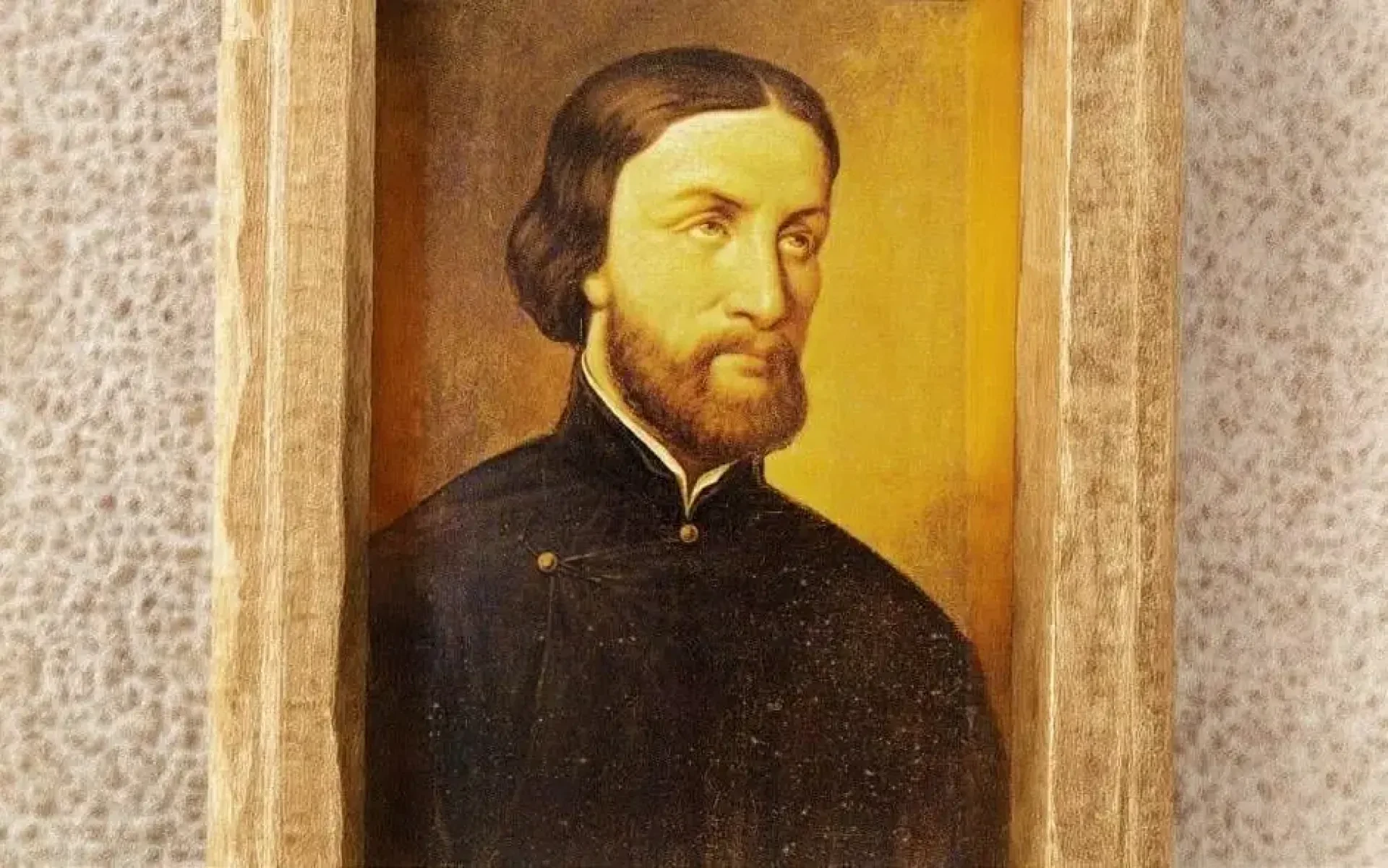
Saint François Isidore Gagelin, also known by his Vietnamese name Kính, was a priest of the Paris Foreign Missions Society. His life stands as a powerful testament to steadfast faith and deep pastoral love for his flock in Vietnam.
From France to the Mission Lands
Saint Gagelin was born on May 10, 1799, in the village of Montperreux, in the Diocese of Besançon, France. Orphaned by his father at the age of two, he was known as an intelligent and exemplary student. In 1817, he entered the Besançon Seminary. Two years later, driven by a desire for missionary work, he joined the Seminary of the Paris Foreign Missions Society. He was ordained a deacon on May 20, 1820, and voluntarily departed for Macau.
In September 1821, Father Gagelin arrived at Thuận An port, near the imperial capital of Huế. On September 28, 1822, Bishop Jean Labartette ordained him to the priesthood at the Nhứt Đông parish in Cổ Vưu, Quảng Trị.
A Demanding Pastoral Journey
In 1825, Father Gagelin was transferred to oversee the Lái Thiêu Seminary in the South, while simultaneously carrying out apostolic ministry in the Sài Gòn and Bà Rịa regions. Bishop Jean Taberd (known as Từ) also entrusted him with responsibility for the arid lands of Phú Yên, Bình Định, and Quảng Ngãi, corresponding to the territory of the present-day Diocese of Qui Nhơn.
Surrendering Himself for His Flock
Following King Minh Mạng’s harsh edict banning Christianity issued on January 6, 1833, Father Gagelin retreated to the northern mountains of Bình Định. His purpose was both to evade the court’s pursuit and to reach out to ethnic minority tribes in the Trường Sơn region.
However, while he was in hiding, many Catholics in Bồng Sơn were arrested and brutally tortured to extract information about the priests’ identities and hiding places. Distressed by the suffering of his flock, Father Gagelin wrote to his Bishop, asking permission to surrender himself if doing so would protect the faithful from being scattered.
In late May 1833, after receiving a reply from Bishop Taberd, Father Gagelin left Long Quan parish—his final place of refuge—and presented himself to the district magistrate of Bồng Sơn, Bình Định province. In his final letter, he expressed: “The prospect of seeing Jesus crucified makes me forget all the pain of death; I desire nothing more than to quickly escape this mortal body to be united with Christ forever.”
Martyrdom and Veneration
In the early morning of October 17, 1833, Father Gagelin was led to the Bãi Dâu execution ground in Huế. By order of the mandarin, twelve executioners carried out the sentence of strangulation. He suffocated and died, completing his sacrifice. The faithful retrieved his body and buried it in the garden of a Catholic family in the Phủ Cam parish.
King Minh Mạng, skeptical of the Christian belief in resurrection, ordered the exhumation of the body a few days later for inspection. In 1847, the remains of this witness to the faith were transferred to the chapel of the Paris Foreign Missions Society for veneration.
Pope Leo XIII beatified him on May 27, 1900. On June 19, 1988, Pope John Paul II canonized him as a saint.
The content about the saint in this post is summarized and paraphrased from the book “Hạnh Các Thánh Tử Đạo Việt Nam” - Lives of the Vietnamese Martyrs (Vietnamese Bishops’ Conference, edited by Bishop Peter Nguyễn Văn Khảm, Tôn Giáo Publishing House, 2018). This post is not a verbatim copy but a re‑presentation based on the original source.