

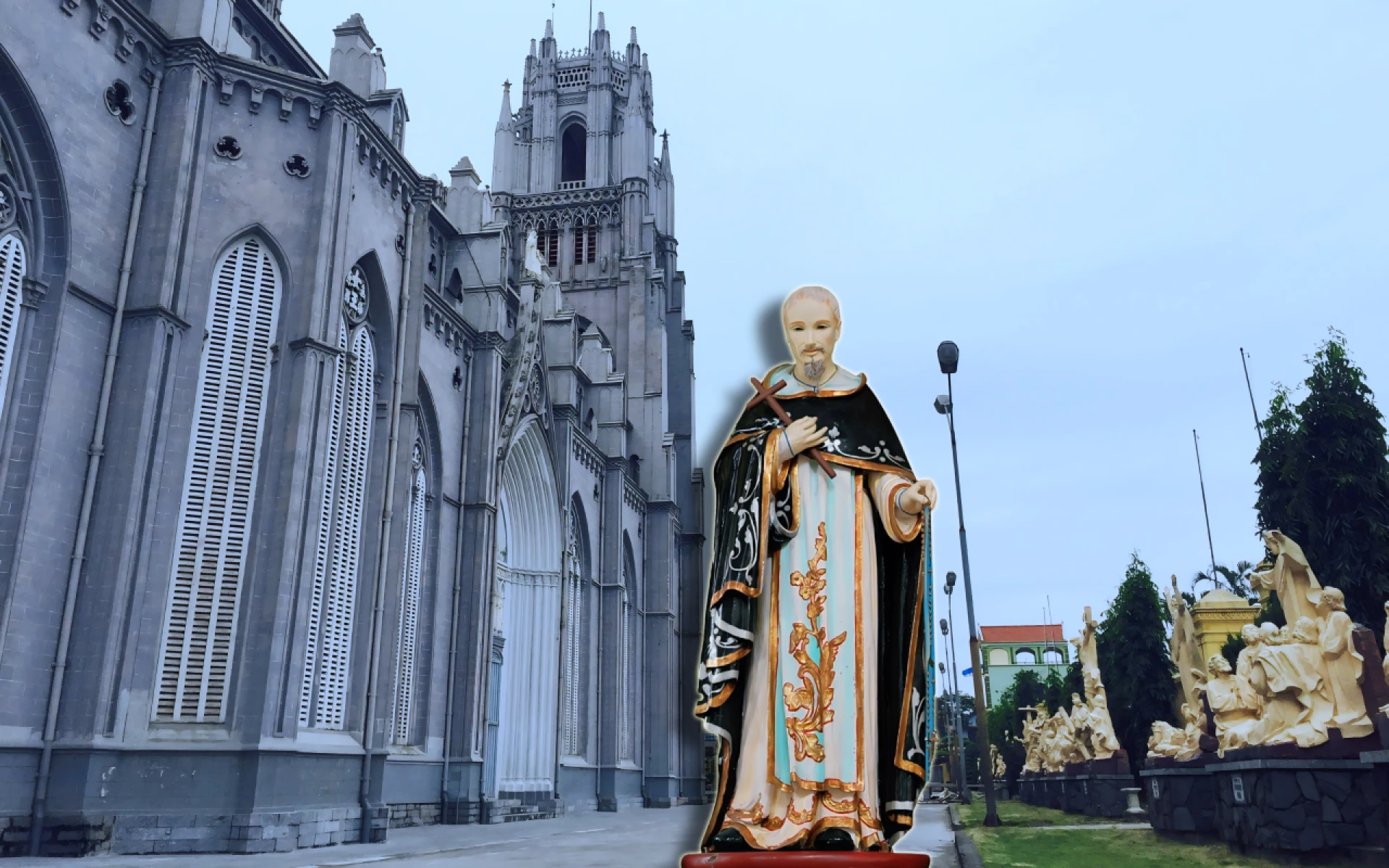
Born in 1764 in Trà Lũ, Phú Nhai parish (now part of Bùi Chu Diocese), he was ordained a priest by Bishop Delgado in 1798. After an earlier arrest and subsequent ransom secured by the faithful, he entered the Dominican Order on July 22, 1807.
Fr. Vinh Sơn was renowned for his zeal, courage, and compassion. He served first in Kẻ Mốt parish, then moved to Kẻ Sặt (Hải Dương). During the intense persecution under King Minh Mạng, he remained with his flock - celebrating Mass secretly in homes at night and visiting the faithful by day, fully aware of the dangers.
When his presence was discovered, he voluntarily left the village to prevent repercussions for the local Catholics, and was later arrested in Lực Điền (Hưng Yên) and brought to Hải Dương. The provincial inspector, who held him in personal regard, urged him to falsely claim he was a physician to secure release. Fr. Vinh Sơn replied: “No, I am not a physician. I am a priest, dedicated to preaching the faith and offering sacrifice to God. For this, I am ready to die - but I will not lie to save my life.”
Officials then drew a circle on the ground, instructing him to step over it as a symbolic act of trampling the Cross. He refused: “To do so would be no different than renouncing my faith.” Unable to sway him, the officials petitioned to transfer him to Nam Định - his native province - but the royal court denied the request and upheld a sentence of execution on the spot.
The sentence was signed on June 20, 1838. During the three weeks of imprisonment, thanks to the intervention of a physician named Hàn, he was spared shackles and allowed visits from fellow believers.
On the morning of June 30, 1838, Fr. Vinh Sơn walked to the execution ground near Bình Lao hamlet, approximately one kilometer west of Hải Dương Citadel. His gentle and dignified bearing moved many onlookers. Before the sentence was carried out, he knelt and prayed fervently. After his execution, officials provided a burial shroud, sewed his head back onto his body, and permitted the Catholics of Bình Lao to take charge of his burial. Eight months later, his remains were transferred to Thọ Ninh Church.
He was beatified by Pope Leo XIII on May 27, 1900, and canonized by Pope John Paul II on June 19, 1988.