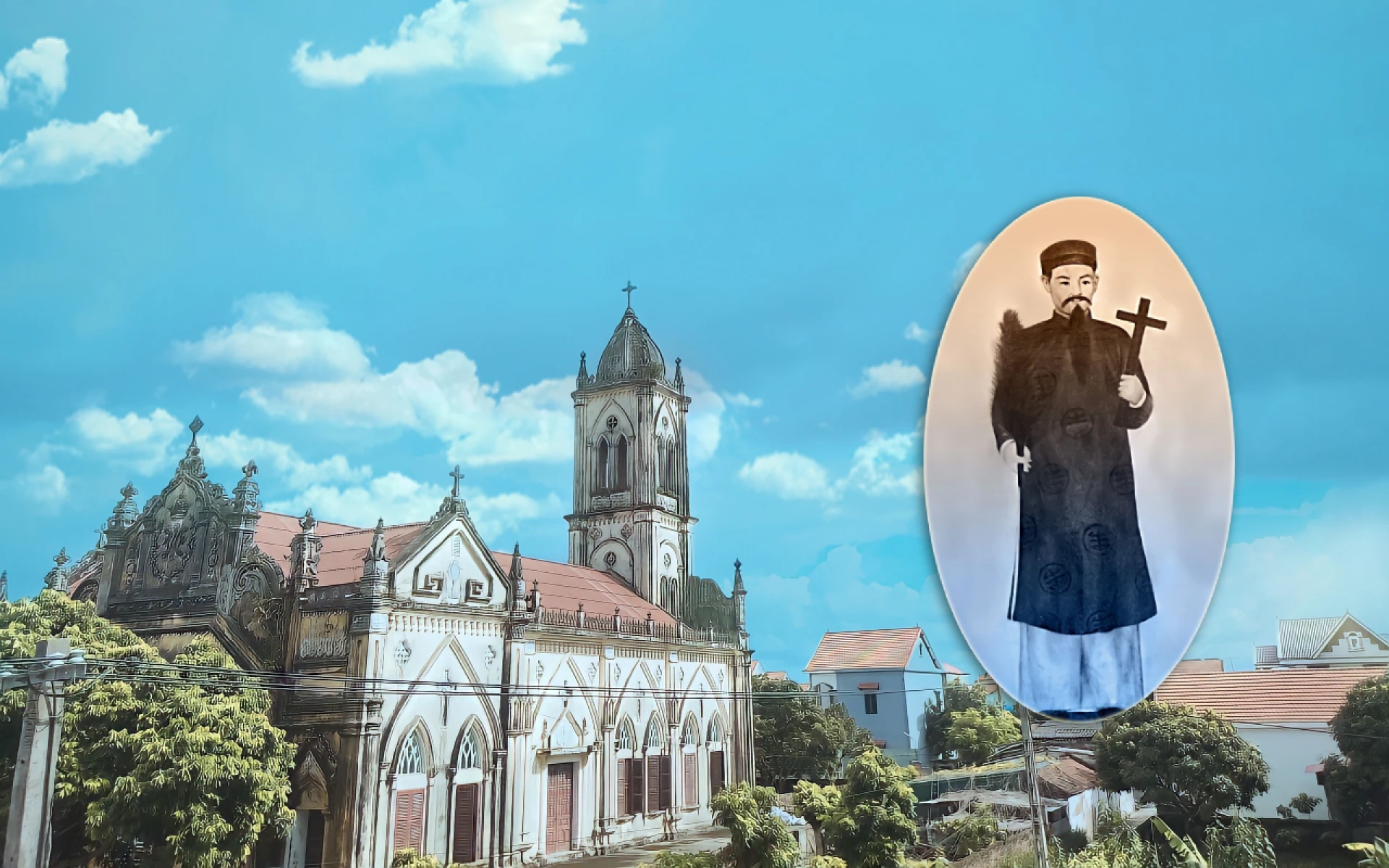
Saint Paul Vũ Văn Đổng was born in 1802 in Lê Xá parish, a community with a long-standing pious tradition belonging to the Central Diocese, now in Hải Hưng province. In his role as parish secretary, he devotedly managed the parish's books and property for six years.
When Emperor Tự Đức issued the edict banning the faith, officials went to each village to check the population, but in reality, they were forcing people to trample on the holy Cross. Those who refused would be put in cangues and taken to the provincial capital. On November 25, 1861, Mr. Đổng was arrested for courageously professing himself a Christian and resolutely refusing to trample on the holy Cross. He was taken to Ân Thi district and then brought to the Hưng Yên magistrate's office.
In prison, he wore a heavy cangue by day and had his feet shackled by night. When soldiers intended to carve the two words "tả đạo" (heresy) on his cheeks, he firmly protested. For this, he was starved until he was exhausted, to the point of having to chew pieces of his shirt fabric to temporarily forget his hunger and thirst.
Despite being weakened, he still did not yield. When soldiers carved the words "tả đạo" on his face, he courageously found a way to erase them and asked a fellow prisoner to carve the two words "chính đạo" (true faith) instead. This action angered the officials, who immediately sent a petition to the capital requesting his execution.
On June 3, 1862, at the execution ground in Nam Định, he composedly prepared himself for a good death. Before his head fell, he cried out the most holy name of Jesus three times, and then the martyr's soul peacefully departed for eternity.
The witness of faith, Paul Vũ Văn Đổng, was declared Blessed by Pope Pius XII on April 29, 1951, and was raised to the ranks of the saints by Pope John Paul II on June 19, 1988.
Saint Paul Vũ Văn Đổng – The Parish Secretary Martyred for the Faith - Vietnamese Martyrs
Share:

Roman Catholicism Last updated: February 1, 2026
Saint Paul Vũ Văn Đổng, the secretary of the Lê Xá parish, steadfastly kept the faith during the time of religious persecution, was beheaded on June 3, 1862, and was canonized in 1988.
Found this article helpful? Share it!
Share: