

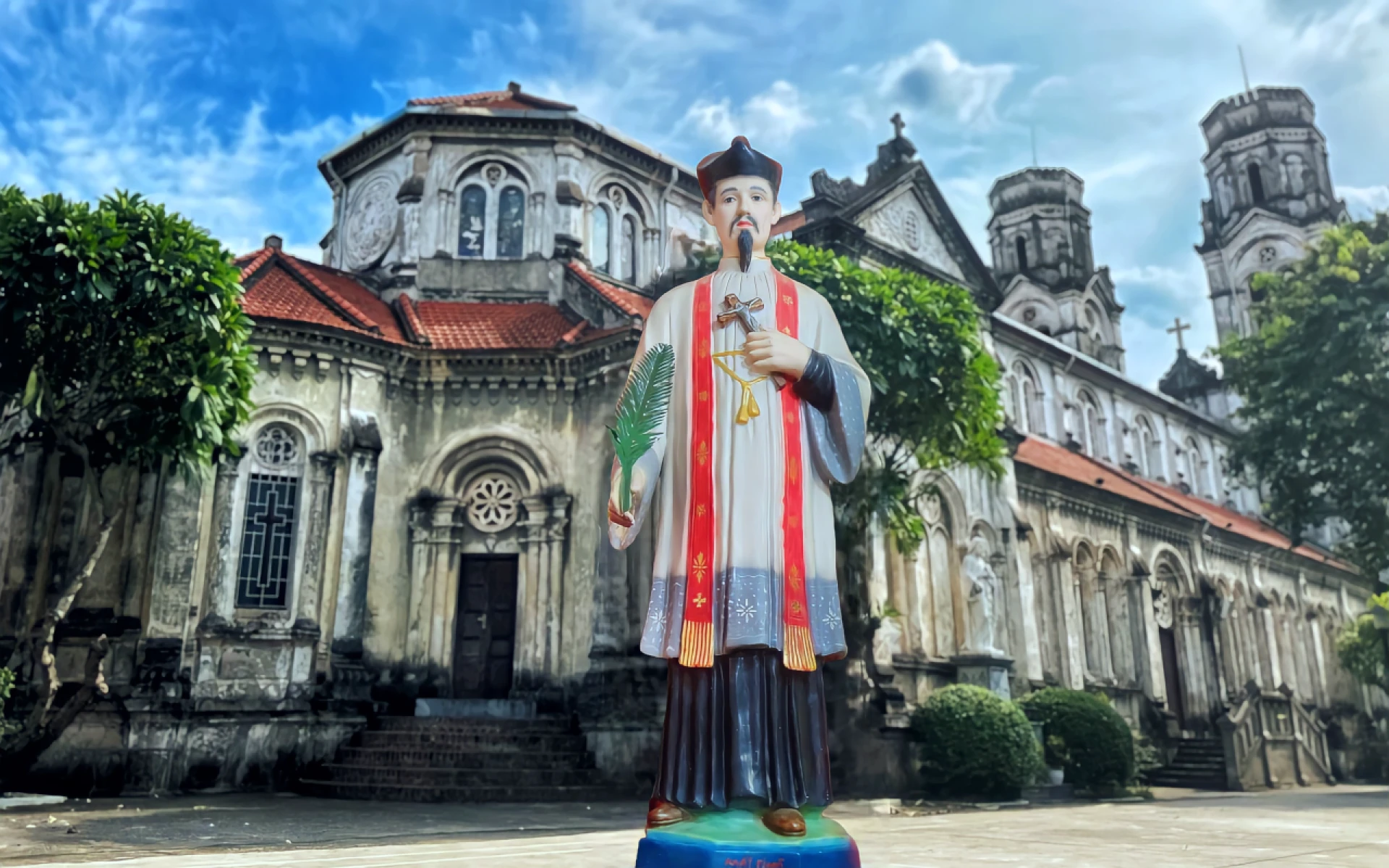
In 1760, in the village of Kẻ Sét (Thanh Trì, Hanoi), a boy named Martinô Tạ Đức Thịnh was born into a large family – he was the eighth of nine children. At the age of 18, his parents planned to arrange his marriage to a gentle, devout young woman, but the young man only asked for a postponement. Later, that young man entered the seminary and was ordained a priest during the reign of Emperor Cảnh Thịnh, a time of strict prohibition of Christianity.
Father Thịnh once served as secretary for Bishop Jacques Longer – Gia, then successively cared for the parishes of Ba Làng and Đồng Chuối, and spent twenty years devoted to the Nam Sang parish. In the final years of his life, he returned as the pastor of Kẻ Trình (Trình Xuyên). Though 80 years old, the elderly priest still rigorously observed the laws of the Church.
One time, due to illness, a parishioner named Mr. Chiền brought the elderly Father Thịnh to his home for care. At that time, mandarin soldiers, upon hearing there were three priests in the area, came and surrounded the place to arrest them. Father Thịnh pretended to be deaf and lay still inside the house. Passing soldiers saw an ailing, elderly country man and paid him no attention. But when he heard that two priests, Nguyễn Ngân and Nguyễn Đình Nghi, had been arrested, the 80-year-old man could no longer remain silent.
A squad leader passing by asked him: "Are you a religious leader?"
The priest solemnly replied: "Yes, I am."
Immediately, the priest was arrested and taken to the communal house of Kẻ Báng village on May 30, 1840. There, he met again with Father Ngân and Father Nghi, along with two laymen, Trần Ngọc Cỏn and Trần Ngọc Thọ, and twenty other faithful. All were put in cangues, chained, and taken to Trại Lá (Nam Định).
During six months in prison, by day the priest wore the cangue, and by night his feet were in stocks. Many times he was brought before the mandarin's court and forced to step over the cross, but these servants of the Lord remained steadfast, patiently enduring lashes and beatings for the name of Jesus.
Faced with the iron will of the three priests, the mandarins pronounced the death sentence by beheading. The sentence was approved by Emperor Minh Mạng. On November 8, 1840, at the Bảy Mẫu execution ground, Father Martinô Tạ Đức Thịnh, Father Nguyễn Đình Nghi, Father Nguyễn Ngân, along with the two laymen Trần Ngọc Cỏn and Trần Ngọc Thọ, were beheaded one after another. The body of the elderly Father Martinô was buried by the faithful at the Vũ Điện family chapel (Hà Nam).
Priest Martinô Tạ Đức Thịnh was beatified on May 27, 1900, and was canonized as a saint on June 19, 1988.