

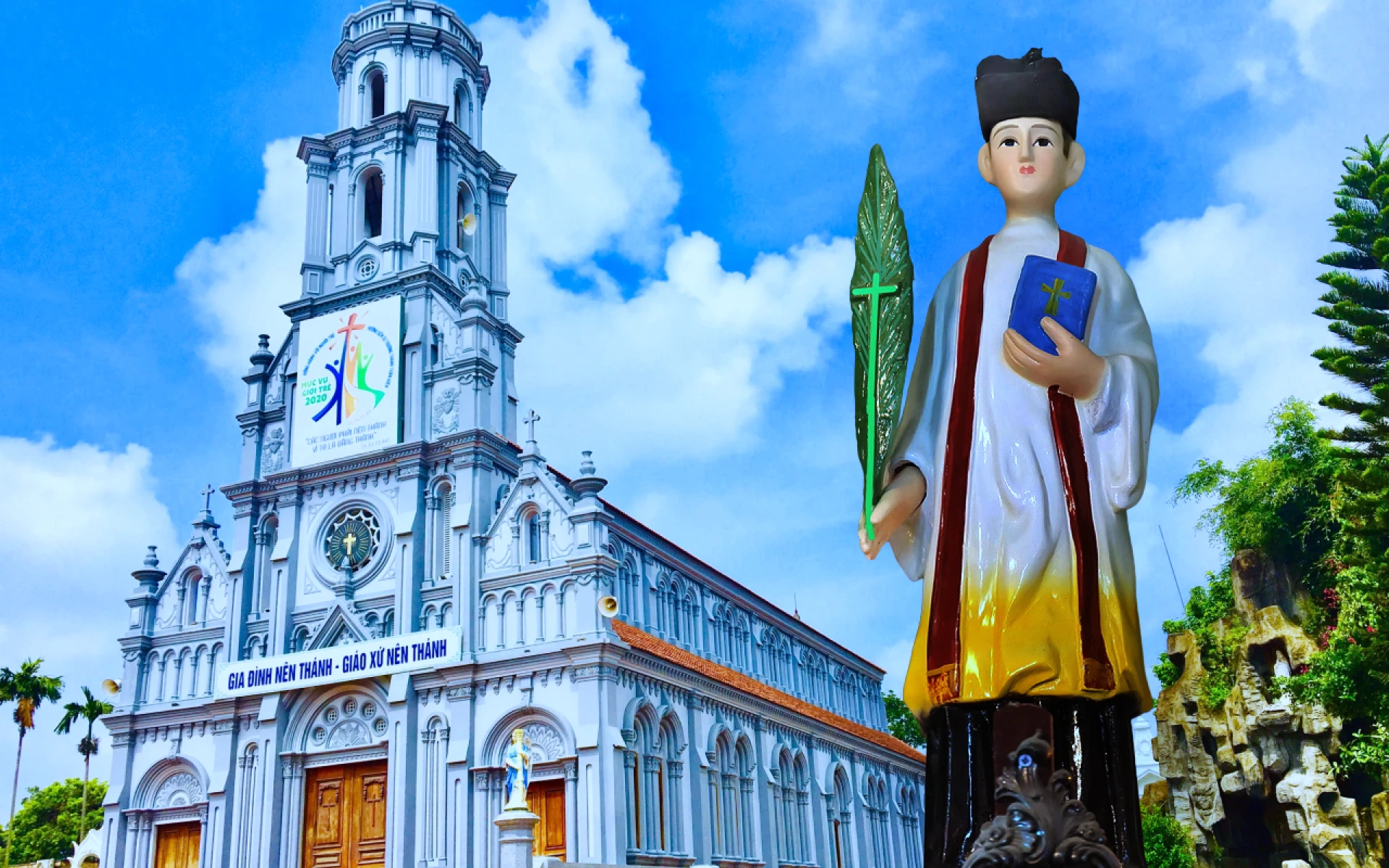
Saint John Đoàn Viết Đạt was born in 1765 in Đồng Chuối parish, Bình Lục district, Hà Nam province. Orphaned of his father from a young age, he soon desired to dedicate himself to God. At age 18, with his mother's consent, he entered the Đồng Chuối rectory and asked Father Loan to let him stay. Afterwards, Father Loan sent him to the seminary to study Latin. Completing the program, he was ordained a deacon and went to assist in parishes. Around February 1798, at age 33, he was ordained a priest and was sent by the Bishop to assist in Hảo Nho parish.
At his new parish, the young priest loved and cared for his flock wholeheartedly, so the parishioners loved him deeply. The pastor, a missionary priest, testified that he possessed the virtues of poverty, obedience, diligence in prayer, and zeal in pastoral work. Though often ill, he never complained or grumbled, thus earning the affection of the Bishop and his brother priests. When preaching, his words were filled with piety, moving sinners to repentance.
In July 1798, the Tây Sơn king issued an edict banning the religion with greater severity. Officials and soldiers were ordered to hunt down priests and parishioners and destroy churches. Facing this danger, the parishioners of Hảo Nho took Father Đạt to the mountains to hide. When the village seemed calm, at night he would come down to the house of the village headman Mai Lễ to celebrate Mass. At the fifth watch, just as Mass ended, a group of soldiers burst in. Seeing the liturgical items still out before they could be hidden, the headman had to confess that a priest was hiding in the house. The parishioners urged him to flee, but he firmly refused: "If I could escape, it would still harm the entire village." Then he surrendered himself to the soldiers.
That day was July 14. The priest was taken away along with Deacon Tâm and three members of the pastoral team: Trùm Mãi, Nhiêu Danh, and Ông Việt. A woman named Dì Phong from the Lovers of the Holy Cross Congregation and several others offered to find a way to rescue him, but Father John Đạt refused. For over three months, while being imprisoned and beaten on the way to Thanh Hóa, he remained joyful and gentle with everyone. Many parishioners came to visit; if they were cheerful, he conversed cheerfully with them, and if they wept, he comforted them. He often exhorted them: "To suffer and die for the faith is the greatest blessing… Our land of Annam has not yet had many who did so."
When brought to the courthouse, the mandarin tempted him, saying he need only step over the cross and he would be returned to his parishioners. Father John Đạt replied: "If I were to step over the cross, it would be abominable; my parishioners would not recognize me as their priest." Seeing his firmness, the mandarin ordered him put in the cangue (wooden collar) and dragged to step over a holy image, but he prostrated himself and venerated the image, so the soldiers could not drag him across.
While awaiting the death sentence, Father Huấn from Bạch Bát parish disguised himself, visited, and administered the Sacrament of Confession to him in prison. On the afternoon of September 19, the priest went to ask the regional commander Điều to show mercy to the faithful and to ask the soldiers to treat his fellow prisoners less harshly. He said: "With sincere heart, I would like my family to invite you all to a meal. I ask that you please show compassion and treat the imprisoned faithful gently."
On October 28, 1798, under King Cảnh Thịnh, at the execution ground in Chợ Rạ, after he sat with hands clasped in prayer, facing toward the church in Trinh Hà village, the death sentence was carried out. Father John Đoàn Viết Đạt gave his life at just 33 years old, having been a priest for less than a year. The faithful brought his remains by boat to the Phúc Nhạc wharf and buried him in the church of that village. Later, to prevent evil people from taking his remains, the parishioners exhumed him and placed the remains in a private home.
He was the second secular priest to die as a martyr (after Saint Emmanuel Nguyễn Văn Triệu, martyred on September 17, 1798). Priest John Đoàn Viết Đạt was beatified on May 27, 1900, and canonized on June 19, 1988.
The content about the saint in this post is summarized and paraphrased from the book “Hạnh Các Thánh Tử Đạo Việt Nam” - Lives of the Vietnamese Martyrs (Vietnamese Bishops’ Conference, edited by Bishop Peter Nguyễn Văn Khảm, Tôn Giáo Publishing House, 2018). This post is not a verbatim copy but a re‑presentation based on the original source.