

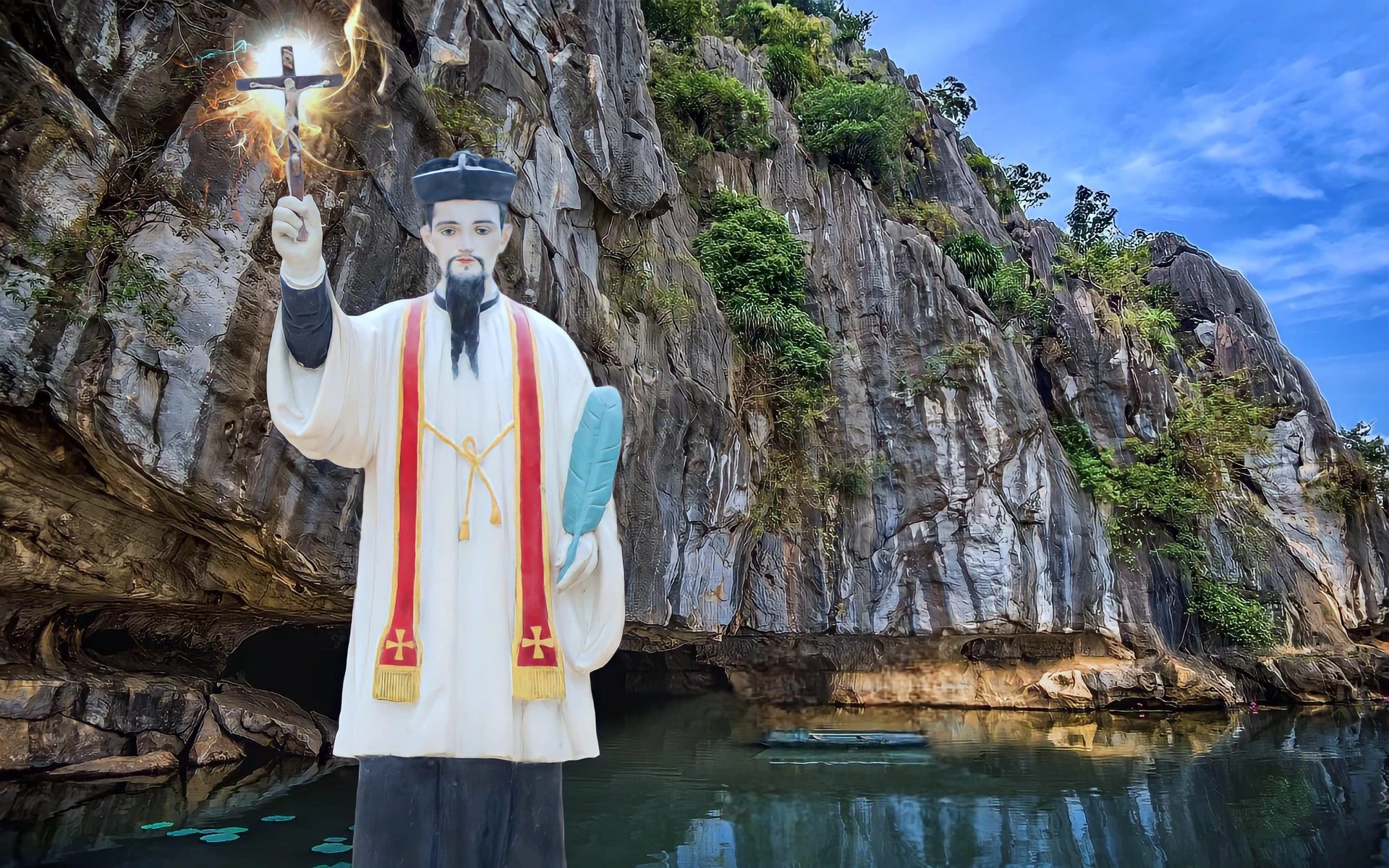
Saint James Đỗ Mai Năm was born in 1781 in Đông Biên village, Vĩnh Lộc district, Thanh Hóa province. His name recorded in the village registry during the Tây Sơn dynasty was Mai Ngũ. From a young age, he lived in the Nhà chung (the common house or residence for clergy and seminarians) and later entered the Kẻ Vĩnh Seminary (Vĩnh Trị) under Bishop Jacques Benjamin Longer – Gia.
When he became a catechist, he was assigned to remain and assist at Kẻ Vĩnh Seminary. During the day, he cared for the sick, and in the evenings, he taught the children of Kẻ Vĩnh village. After a few years, his superiors called him to study at the Major Seminary and ordained him a priest when he had just turned 32 years old.
Father James Năm was a gentle and amiable man, diligent in prayer and the rosary. Notably, he had compassion for the poor and often helped them with food, clothing, and medicine.
In the middle of the Minh Mạng dynasty, when the edict prohibiting Christianity was issued, churches and rectories were destroyed. The Nhà chung in Kẻ Vĩnh was forced to disperse, and Father Năm had to take refuge in the home of Trùm Tốn in Kẻ Nguồi for about three or four years. After the persecution subsided, he returned to Kẻ Vĩnh.
Not long after, the arrests of Christians intensified again. Father Năm once again had to hide in the home of Trùm Đích in Kẻ Vĩnh village. Two individuals named Tỉ (originally from Đông Mặc) and Xuân (originally from Tiểu Tức Mặc, Mỹ Lộc district, Nam Định) denounced him to the Provincial Governor of Nam Định, Trịnh Quang Khanh.
On the morning of May 11, 1838, the Provincial Governor arrived by boat at the Kẻ Vĩnh pier, took a seat at the village communal house, and summoned everyone aged 18 and above to appear. At that moment, Father Năm was tying his sash and rolling up his sleeves, preparing to cook a meal with the villagers, when soldiers encountered him. Seeing his fair complexion and handsome beard, the soldiers asked: "Who are you? Are you the Priest?" The priest replied: "I am a person from this house." Tỉ and Xuân immediately pointed him out, saying: "That is precisely the priest staying at Trùm Đích's house." Father Năm calmly said: "Yes, I am the priest." He was bound along with Trùm Đích and handed over to the official.
Before the official, the priest still declared himself to be a priest. The official asked: "The imperial court strictly forbids the religion of Jesus, why do you not return to your home and work instead of preaching?" He then asked: "Will the priest step over the cross?" Father Năm replied: "Your Excellency, we do not step over the cross." He, along with Trùm Đích, the village head, and Trùm Đích's son-in-law, were placed in cangues and escorted to Nam Định. Upon arrival, the officials again pressured him to step over the cross, but he remained resolute in his refusal.
On August 12, 1838, Father James Đỗ Mai Năm, Trùm Đích, and Lý Mỹ were beheaded at Bảy Mẫu. Later, when peace had been restored, the Nhà chung built a tomb and hung a parallel couplet in remembrance:
"Hoành hoành nghĩa khí quần giam Cụ
Lẫm lẫm trung thành vạn cổ sư."
Father James Đỗ Mai Năm was beatified by Pope Leo XIII on May 27, 1900, and was canonized as a saint by Pope John Paul II on June 19, 1988.
The content about the saint in this post is summarized and paraphrased from the book “Hạnh Các Thánh Tử Đạo Việt Nam” - Lives of the Vietnamese Martyrs (Vietnamese Bishops’ Conference, edited by Bishop Peter Nguyễn Văn Khảm, Tôn Giáo Publishing House, 2018). This post is not a verbatim copy but a re‑presentation based on the original source.