

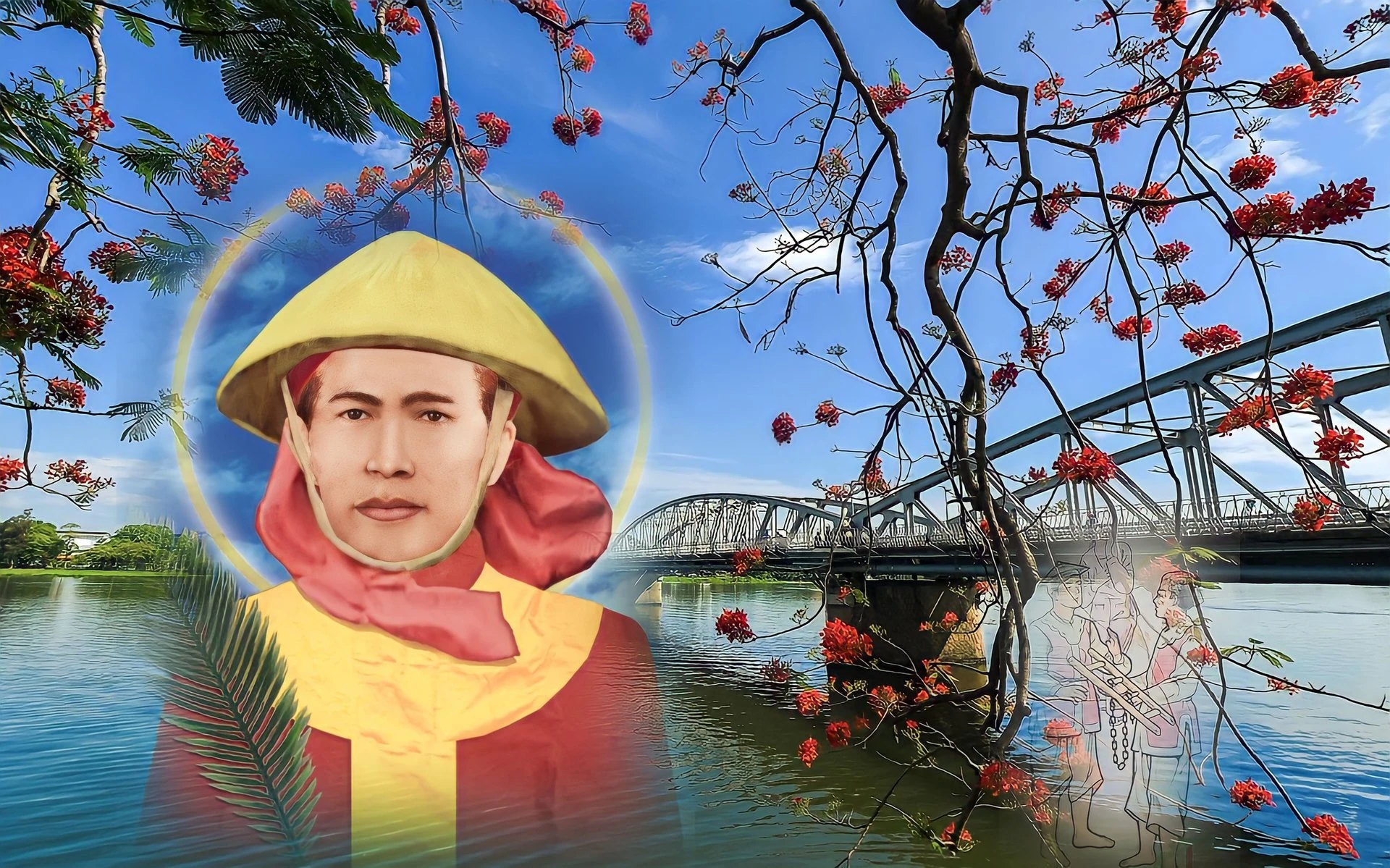
Life and Vocation in the World
Saint Andrew Trần Văn Trông was born in 1814 into a devout Catholic family in Kim Long, Phú Xuân (now part of the Diocese of Huế). Having lost his father early and being the only son, he shouldered family responsibilities from a young age. Initially, Andrew studied literature, but due to financial difficulties, he later switched to weaving silk for the royal family in the Thợ Đúc community.
At the age of 20, because his meager wages were insufficient to support his livelihood, Andrew decided to enlist in the military, becoming a soldier specializing in weaving silk for the imperial court. Despite living in a military environment, he always maintained his Christian faith.
Trial of Faith and Steadfastness
During the reign of King Minh Mạng, strict edicts banning Catholicism were issued. In November 1834, the court ordered Catholic soldiers to report themselves. With courage and without hesitation, Andrew Trông and twelve comrades from the Thợ Đúc area voluntarily reported to the authorities. They were all arrested and imprisoned at Trấn Phủ.
There, mandarin officials demanded that the men renounce their faith and trample on the Cross to prove their loyalty to the king. All thirteen Catholic soldiers resolutely refused this demand. Faced with such firmness, the authorities employed various forms of severe torture. One by one, twelve of Andrew’s comrades could not endure the suffering and gave in; they were released and continued to serve the court. However, Andrew Trần Văn Trông remained steadfast, preferring death over betraying his God.
Filial Last Words at the Execution Ground
On November 28, 1835, the sentence of beheading against Andrew Trông was carried out at Chợ An Hòa. Upon hearing the news of his martyrdom, the witness of faith spent time fasting and praying to prepare his soul.
Learning that her son was about to be led to the execution ground, Andrew’s mother hurried to meet him. Their final encounter took place in tears but was filled with faith, love, and hope. His mother asked him, “My son, during your imprisonment, do you owe anyone anything? If so, tell me so I can settle it, ensuring you have no worldly attachments.”
Andrew bravely replied, “Mother, do not worry. I owe nothing to anyone. Mother, please be at peace and follow God courageously. I promise to always pray for you.”
After these final words, full of filial piety and faith, Andrew bowed to bid farewell to his mother and calmly proceeded to the execution ground. His mother continued to walk closely beside him, encouraging him to remain firm in his faith until the very end.
Martyrdom and Veneration
After the beheading was carried out, his mother courageously approached the mandarins to request her son’s body. She used the hem of her own áo dài (traditional Vietnamese long dress) to wrap the bloody head of her beloved son, demonstrating sacred maternal love and respect for the martyr. The remains of Saint Andrew Trần Văn Trông were subsequently buried within the Kim Long Church.
In admiration of his steadfast faith, Pope Leo XIII elevated him to the rank of Blessed on May 27, 1900. Later, on June 19, 1988, Pope John Paul II canonized him as a Saint along with other Vietnamese martyrs.
The content about the saint in this post is summarized and paraphrased from the book “Hạnh Các Thánh Tử Đạo Việt Nam” - Lives of the Vietnamese Martyrs (Vietnamese Bishops’ Conference, edited by Bishop Peter Nguyễn Văn Khảm, Tôn Giáo Publishing House, 2018). This post is not a verbatim copy but a re‑presentation based on the original source.