

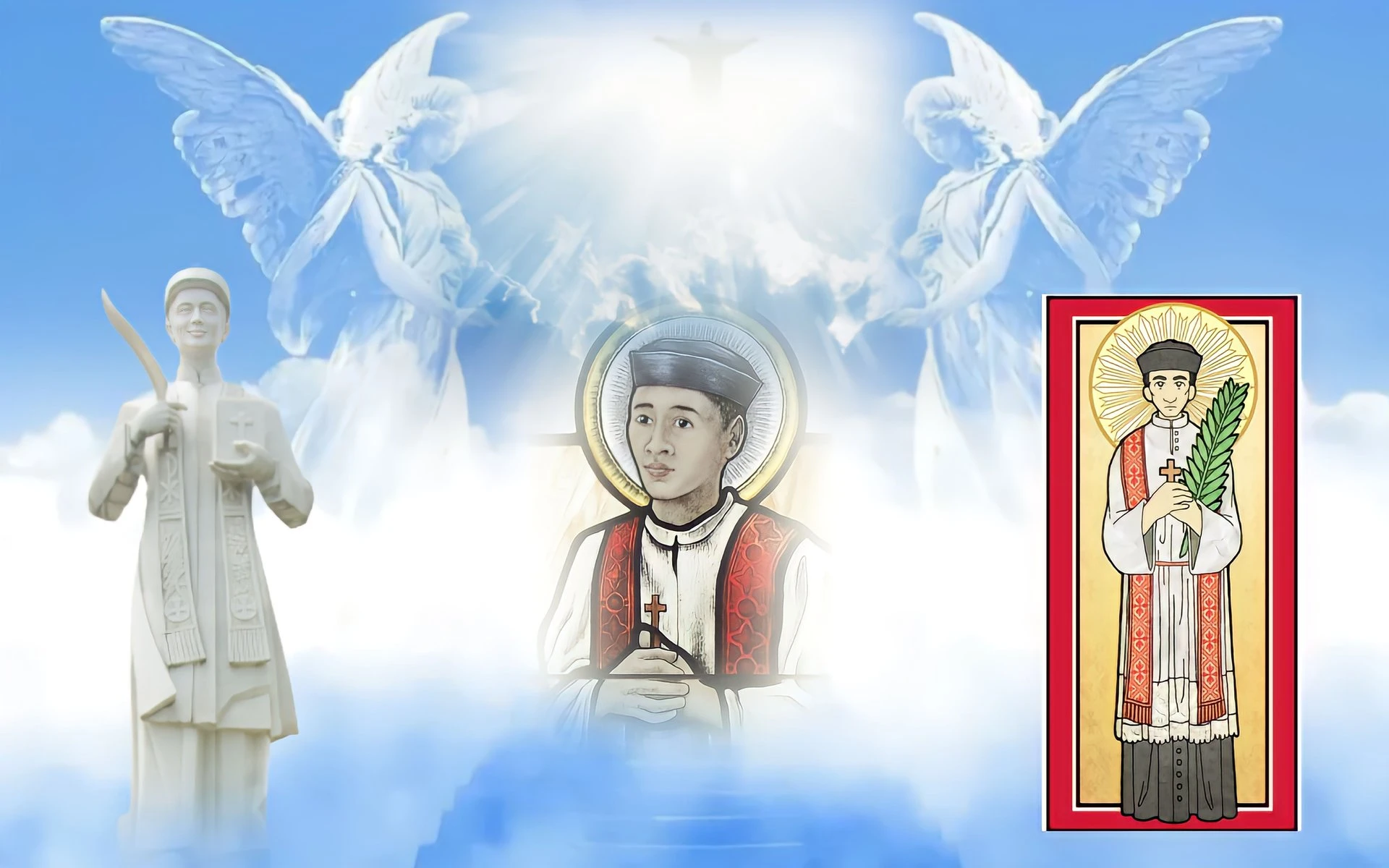
Life and Vocation
Saint Andrew Trần An Dũng was born in 1795 in the town of Kinh Bắc (now part of Bắc Ninh Province). When his family moved to Kẻ Chợ, young Andrew followed and requested to join the Church. He lived at the rectory with Father Chính Lan, the superior of the Minor Seminary of Kẻ Vĩnh.
Exceptionally intelligent, Andrew could memorize texts after reading them only twice. He was proficient in both Chữ Nho (Sino-Vietnamese characters) and Latin. With his gentle, cheerful, and polite demeanor, he earned the respect of mandarins and scholars of the time. After three years of study at the seminary, he was ordained a priest on March 15, 1823.
Pastoral Ministry
After ordination, Father Andrew was assigned to assist Father Khiết in the parish of Đồng Chuối for four months, then supported Father Thi for three years, and later served under Father Duyệt in the parish of Sơn Miêng. Bishop Du appointed him as the pastor of Thanh Độ for a few months, before transferring him to become the pastor of Kẻ Đầm when he was over forty years old.
Father Andrew was known for his fervent preaching and fair judgment in secular matters. His gentle manner won the obedience and affection of the faithful. He lived a simple life, strictly observing fasting days throughout the year. During the period of persecution, he secretly visited and aided the poor. When going to administer Last Rites to the sick, he did not allow servants to accompany him to avoid implicating them. Instead, he sent catechists to various parishes, urging the faithful to come to him for confession.
Arrest and Refusal of Ransom
After establishing a rectory in the village of Kẻ Sui for seven or eight months, Father Andrew was arrested and taken to the provincial authorities. Mr. Thìn bribed District Magistrate Hào Khánh of Đôn Thư and the provincial mandarin to secure his release, falsely claiming the priest was a relative. Consequently, he was released and adopted the name Lạc.
However, Father Lạc and Father Thi were later arrested by a French village chief and his servants while meeting to hear each other’s confessions. Although the faithful raised money for their ransom, the two priests were re-arrested by the district magistrate on October 10, 1839.
When believers offered to mortgage their properties to pay the ransom, and officials suggested that he could be carried out in a palanquin if money was provided, Father Lạc firmly refused. He stated, “This is the third time I have been arrested. I resolutely accept God’s will for me; do not attempt to ransom me.”
Martyrdom and Glory
Three days later, the two priests were transferred to the provincial capital of Kẻ Chợ, where they were interrogated three times. When ordered to step on the cross to secure their release, they steadfastly refused. Knowing death was imminent, they spent their time in prayer and spiritual preparation. Father Lạc comforted Father Thi, saying, “Let us endure this suffering for a little while longer so that we may meet the Supreme Father.”
On November 1, 1839, Mr. Thìn brought Holy Communion to the two priests. On December 21, 1839, they were led to the execution ground outside Cầu Giấy Gate. Before the execution, Father Lạc asked the soldiers for a moment of peace. He joined his hands in prayer for a short time and then calmly accepted beheading alongside Father Thi.
The faithful retrieved the bodies of the two martyrs and buried them at the house of Mrs. Lý Quý near Cầu Giấy. They were later exhumed and transferred to Hanoi Cathedral, where they remain to this day.
Pope Leo XIII beatified him on May 27, 1900. On June 19, 1988, Pope John Paul II canonized him as a saint.
The content about the saint in this post is summarized and paraphrased from the book “Hạnh Các Thánh Tử Đạo Việt Nam” - Lives of the Vietnamese Martyrs (Vietnamese Bishops’ Conference, edited by Bishop Peter Nguyễn Văn Khảm, Tôn Giáo Publishing House, 2018). This post is not a verbatim copy but a re‑presentation based on the original source.