

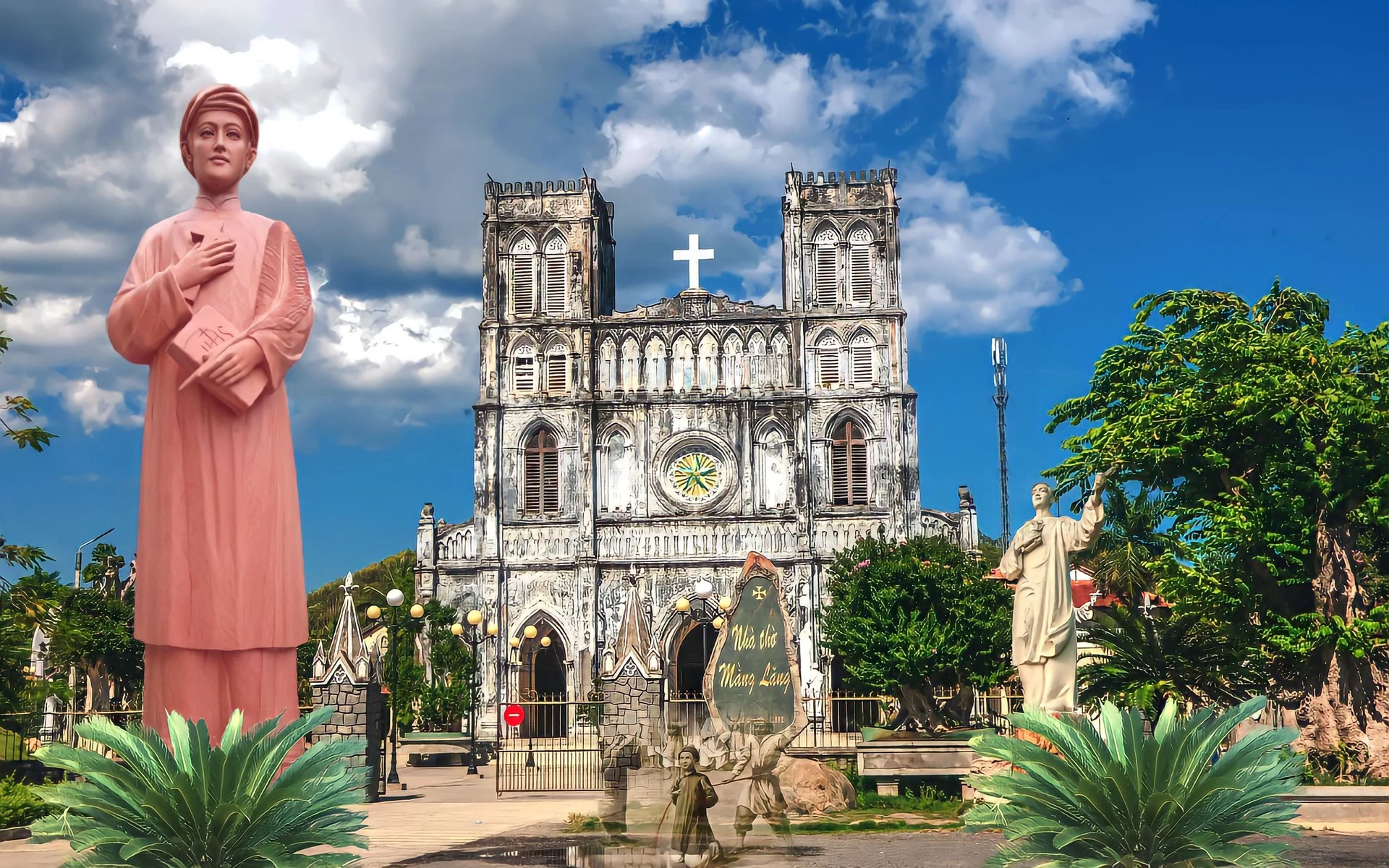
Biography and Vocation
Blessed Andrew Phú Yên was the youngest son in a poor family in a small coastal hamlet, now part of Mằng Lăng Parish, Phú Yên Province, within the Diocese of Qui Nhơn. Although no civil records have been found detailing his birth name, Father Alexandre de Rhodes confirmed that Andrew was 19 years old when he was martyred in 1644, indicating he was born in 1625. The name Andrew Phú Yên, comprising his baptismal name and hometown, was officially recognized by the Holy See.
His mother, Joanna, though widowed, diligently educated her children. In 1641, she brought Andrew to Father Alexandre de Rhodes and requested his baptism. That same year, at the age of 17, Andrew was accepted into the community of catechists by Father de Rhodes. After undergoing training in catechism and culture, he made his promises in Hội An in 1643. As the youngest member, he had the honor of accompanying Father de Rhodes and nine other outstanding brothers on their missionary journey through Phú Yên, Quy Nhơn, Quảng Nam, Quảng Ngãi, and Quảng Bình.
A Noble Sacrifice
In July 1644, Mr. Nghè Bộ ordered the imprisonment of an older catechist also named Andrew and sought to arrest Ignatius, the eldest brother in the group. When soldiers arrived at Father de Rhodes’s residence, only the young Andrew was present. Reflecting wisely, Andrew realized that if Ignatius—the wise and resilient eldest brother—were captured, the entire group would suffer severe consequences. Conversely, as the youngest, his loss would have less impact on the community’s operations.
With great courage, Andrew took full responsibility to protect his brother. He willingly allowed the soldiers to bind him and confiscate holy images and religious items. Throughout the journey to prison, he continuously preached to his captors about avoiding hell and attaining heaven. In prison, the two Andrews were held together. They spent the night in conversation, encouraging each other to remain steadfast in faith as they prepared for the impending "battle."
The Death Sentence and Martyrdom
At the tribunal, despite Father de Rhodes’s efforts to intervene, the magistrate released the older Andrew but insisted on executing the 19-year-old youth. This decision was driven by Andrew’s bold declaration: “I wish I had a thousand lives to offer them all to God in repayment for His grace.”
Upon hearing the death sentence, Andrew remained calm and joyful. He asked those visiting him to pray for his perseverance and repeatedly stated: “Let us repay the love of our Lord with love; let us repay His life with our lives.”
Around 5:00 PM on July 26, 1644, Andrew was escorted to Gò Xử (now located in Phước Kiều Hamlet, Hội An Parish, Diocese of Đà Nẵng) for execution. In the presence of numerous faithful and locals, including Father de Rhodes, he exhorted them: “Remain firm in the faith, do not grieve over my death, and join in prayer that I may remain steadfast to the end.” Andrew peacefully gave up his life while continually invoking the holy name “Jesus.”
Legacy and Beatification
After his martyrdom, Father de Rhodes transported Andrew’s body to Macau for burial, while his head was sent to the Superior General’s House of the Society of Jesus in Rome, where it remains today. Recognizing his contributions and exemplary life, the Vietnamese Episcopal Conference designated July 26 as the Day of Vietnamese Catechists. On March 5, 2000, Pope John Paul II beatified Andrew Phú Yên.
The content about the saint in this post is summarized and paraphrased from the book “Hạnh Các Thánh Tử Đạo Việt Nam” - Lives of the Vietnamese Martyrs (Vietnamese Bishops’ Conference, edited by Bishop Peter Nguyễn Văn Khảm, Tôn Giáo Publishing House, 2018). This post is not a verbatim copy but a re‑presentation based on the original source.